When Big Oil Mistook a Bubble for the Future
European oil majors treated the extraordinary conditions of 2020 and 2021 as evidence of a durable industrial future. This article examines how cheap money, inflated valuations and policy momentum distorted strategy.

🎧 Prefer to listen?
There are periods in corporate history when strategy stops feeling like a choice and starts looking like a surrender to the mood of the age. The European oil majors’ rush into the energy transition in 2020 and 2021 was one of those moments. This was not simply a case of boardrooms becoming sentimental about climate policy, or chief executives forgetting how returns work. A whole industry was being told, and in places had started to believe, that history was preparing to leave it behind. The kind of image circulating at the time was the old Fifth Avenue comparison: in one photograph, a single car is lost among horses; a few years later, a single horse is lost among cars. That was the fear. Oil majors were being invited to imagine themselves not as resilient incumbents with irreplaceable assets, but as horse owners on the eve of the motor age: custodians of the old system, watching the new one arrive. In that atmosphere, several signals all pointed in the same direction at once: politics, shareholders, ESG, Covid, zero interest rates, clean-energy equity euphoria and the fear that the future had already been priced.
Yet the same mood produced very different responses. BP, Shell, TotalEnergies, Equinor, Repsol and Eni all moved, to varying degrees, toward a broader “energy company” identity. ExxonMobil, Chevron and ConocoPhillips did not. The divergence was not only about geological portfolios or engineering cultures, although those mattered. It was also about political economy. European boards faced a legitimacy problem. US boards faced a returns-and-capital-discipline problem. That helps explain why European companies felt permission, and in some cases pressure, to redefine what an oil major was supposed to be.
The oddity is that shareholders did not really stop them. That is partly because shareholders do not run public companies in the way people often imagine. They own the company, but they do not usually vote on every strategic turn. Their rights are largely negative: vote against directors, vote against pay, support activists, requisition resolutions, or sell the shares. Strategy belongs to the board until the consequences become sufficiently painful. But institutional money should not be let off the hook, especially in Europe. Large shareholders, stewardship teams and ESG-conscious asset managers helped create the atmosphere in which transition strategies were not only tolerated, but often encouraged. They asked for climate plans, voted for transition reports, rewarded the language of alignment and disclosure, and only later became more forceful about returns. Investors were therefore not simply judging the strategy after capital had already been allocated. In many cases, they had helped make the strategy boardroom-safe in the first place.
That created a dangerous time lag. In 2020, a European major could present transition strategy as good governance, long-term risk management and capital-market adaptation. A “Say on Climate” vote or an advisory AGM resolution could provide procedural cover, but it did not necessarily mean shareholders had properly underwritten the return profile of every low-carbon business being built. Many investors were saying different things at once. Some wanted Paris alignment. Some wanted higher distributions. Some wanted better disclosure. Some wanted lower upstream exposure. Some wanted the company to maintain hydrocarbon cash flows but clean up emissions. The resulting shareholder message was not a single instruction; it was a noise cloud from which boards could extract the signal they preferred.
Covid then supplied the shock that turned this pressure into a strategic rupture. The old oil-major model looked humiliated. Demand collapsed, mobility stopped, refining was strained, dividends were questioned and oil equities traded as if they were ex-growth melting ice cubes. It became difficult for some European boards to stand up and say that the answer was simply to keep doing oil and gas better. The sector was not merely unpopular; it appeared, briefly, to be structurally impaired. In that environment, “we are becoming an integrated energy company” sounded less like a slogan and more like an escape route.
This was the most seductive part of the episode. The transition thesis did not present itself merely as a moral or political obligation. It presented itself as a valuation argument. Boards could tell themselves that they were not sacrificing returns for social legitimacy; they were positioning the company for the multiple that the market now appeared willing to award to clean-energy platforms. The sector’s next big mistake was to confuse the market’s appetite for scarce clean-energy pure plays with the value of owning lower-return transition assets inside an integrated oil company. Investors might pay a premium for a clean-energy pure play during a bubble, but that did not mean they would re-rate a supermajor for recycling upstream cash into crowded, capital-intensive, lower-return businesses.
This is where the European and US divergence becomes easier to understand. Europe had a more supportive political and legal environment for the transition narrative. Climate policy was more embedded, ESG stewardship was more mainstream, and social licence carried more weight in boardroom language. European oil companies had to explain not only how they would make money, but why they deserved to exist in a net-zero world. That pushed them toward identity change: not just “we produce oil and gas more efficiently,” but “we are becoming a broader energy provider.”
The US majors operated in a different political economy. ExxonMobil and Chevron faced climate pressure, but they also had a more defensible domestic narrative around energy security, shareholder returns, national industrial strength and hydrocarbon excellence. Their shareholder base was less likely to reward a European-style reinvention, and the political environment was too polarised to provide a stable mandate for one. Even the Engine No. 1 campaign at Exxon was not really a demand that Exxon become BP. It was a demand for better board capability, capital discipline and long-term strategic credibility. The US answer was not “ignore the transition,” but it was much more likely to mean lower operational emissions, carbon capture, hydrogen, biofuels, lithium or other industrial adjacencies than a wholesale move into power and renewables.
The European majors were not all the same. TotalEnergies probably handled the period best because it did not make the transition a repudiation of hydrocarbons. Its rebrand was real, and its power and renewables build-out was meaningful, but it retained a clear hydrocarbon engine, especially LNG. Shell moved toward the transition, but it was more cautious than BP and has since put stronger emphasis back on LNG, distributions, cost reduction and capital discipline. Equinor and Repsol were more heavily swayed than the US majors, particularly in renewables, but both have had to recalibrate as costs, rates and investor tolerance changed.
Eni also deserves a mention, and regular readers will know I like the company a lot. Its model was distinctive: businesses such as Plenitude, its power-and-retail arm, and Enilive, its mobility-and-biofuels business, were separated into partly standalone platforms able to attract their own capital. That was the clever bit. The transition businesses were not simply internal drains on the parent balance sheet; they were structured to help capitalise themselves, while the group kept its upstream business clearly at the centre of the investment case.
Then the world economy reopened, and the assumptions embedded in the 2020 transition trade began to break. Cheap money had made long-duration clean-energy assets look easy to justify; the post-Covid rebound revealed that the physical economy — steel, vessels, turbines, grids, labour, gas, oil and logistics — was far tighter than the financial economy had assumed.
Inflation returned, and for many executives and investors it was almost a new experience. Rates rose. Supply chains tightened. Offshore wind costs soared. Power-market economics looked much more complex. Oil and gas cash flows surged. Energy security returned to the centre of politics after Russia’s invasion of Ukraine.
What had looked in 2020 like a prudent migration away from a declining sector began to look, by 2022 and after, like a serious misallocation of capital. Billions had been pushed into businesses whose economics were deteriorating just as the supposedly declining hydrocarbon portfolio was throwing off enormous cash. Shareholders were being pummelled twice: first by the opportunity cost of underweighting the best part of the portfolio, and then by the derating attached to a strategy the market no longer believed. The question became much more brutal: had these companies built advantaged transition businesses, or had they spent billions moving away from the best part of their portfolio into lower-return activities? If so, how slow, costly and painful would the unwind be — and how much damage had been done to their core cash-generating upstream division in the meantime?
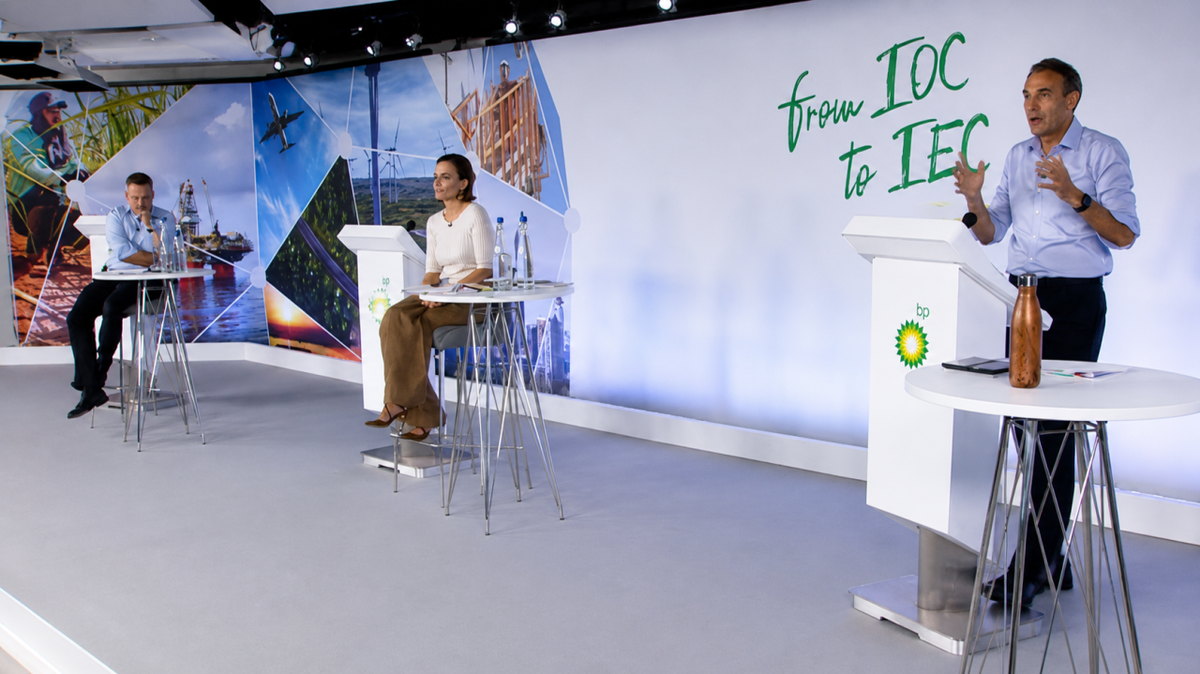
BP was the company that went the whole way, and that is why it is the clearest case study rather than merely another European example. Its 2020 strategy was not just a modest transition overlay. It was an identity break: from international oil company to integrated energy company. The company targeted a sharp reduction in oil and gas production, a large increase in low-carbon investment and a new purpose around “reimagining energy.” Shell and TotalEnergies changed too, but BP’s version was more radical because it turned the transition into the central strategic story rather than an adjacent growth theme.
There were BP-specific reasons why it was more susceptible to going further. The UK was outside the EU, but it was not outside net-zero politics. The UK government had legislated for net zero, London capital markets were highly ESG-sensitive, and BP was operating in a political-financial environment where climate credibility mattered. BP also had a weaker “just keep doing this” story than Exxon or Chevron, and arguably than Shell or TotalEnergies. It still sat in the shadow of Macondo, had less of a commanding hydrocarbon growth narrative, and Covid exposed the fragility of BP’s old dividend-led income-investor appeal. A new CEO could therefore present not just a financial reset, but a corporate reinvention.
Like many large companies facing a complex strategic question, BP brought in management consultants to help work through the answer. The risk with that lens is not that consultants cannot produce elegant strategies. It is that the wrong assumptions can be turned into a very persuasive programme. A tougher capital-markets challenge might have asked different questions before the strategy hardened: would investors really reward BP for owning assets they were then valuing most highly as scarce clean-energy pure plays? What happens if discount rates normalise? How much value is lost by moving capital away from advantaged upstream? Are these new businesses capable of earning the returns required inside an oil major? What emerged instead was a sweeping strategy reset, with a new language, a new “integrated energy company” identity, new businesses and functions, and a vocabulary of purpose, agility, sustainability and organisational redesign. Advisers can frame choices, test options and turn an argument into a programme, but they do not relieve a boardroom of judgment. BP’s board and executive team chose the mandate, accepted the answer and sold it with conviction. The point is that BP’s pivot became a complete transformation programme, made more persuasive by a moment when the boardroom slide deck, the ESG mood, the clean-energy equity market and zero-rate finance all told the same story.
BP’s later retreat was therefore not just a company-specific reversal, but a verdict on the conditions that produced the original strategy. When rates were zero, clean-energy equities were soaring and oil demand looked wounded, the transition pivot could be framed as value creation. Once hydrocarbons were generating exceptionally strong cash again and the economics of renewables had been crushed by inflation, the strategy was exposed as hopelessly overextended. BP had not merely misjudged the pace of the transition; it had mistaken a temporary capital-market regime for a durable industrial future. It did not simply discover in 2025 that oil and gas still mattered. Its board discovered that shareholders, it appeared, had never really given it unlimited permission to become something else.
The US majors may have looked less fashionable in 2020 and 2021, but they were also less exposed to the forces pushing European boards toward reinvention, and therefore had more room to remain strategically coherent. TotalEnergies looks more credible than BP because it treated the transition as additive to a still-visible hydrocarbon engine. Eni was cleverer still in places, structuring transition businesses so they could attract their own capital rather than simply draw on the parent balance sheet, while keeping upstream clearly at the centre of the investment case. Shell has moved back toward a similar logic. BP, too, has altered course, but the retreat has been slow, faltering and forced by events rather than owned early as a strategic correction.
The pivot by European majors was therefore not just a climate story. It was a Covid story, a free-money story, a clean-energy bubble story, a governance story and a political-economy story. Boards were not forced into it, but they were strongly invited. Shareholders did not stop it because the warning signs were obscured by the market mood and because governance gives boards wide latitude until outcomes deteriorate. For a brief period, reinvention looked safer than continuity.
That is what makes the episode so fascinating. It had almost everything: a humiliated incumbent industry, a global crisis, a speculative boom, political pressure, consultant logic, boardroom overconfidence, shareholder ambiguity and, finally, the revenge of the physical economy. A fashionable strategy that forgets where the returns come from will eventually be found out.