Oil Rich, Equity Poor: How Debt Ate Tullow Shareholders
Debt can let shareholders control more oilfields, but it can also leave them with little of the economics. Tullow’s latest shock shows how valuable producing assets can survive while leverage erodes the equity beneath them.

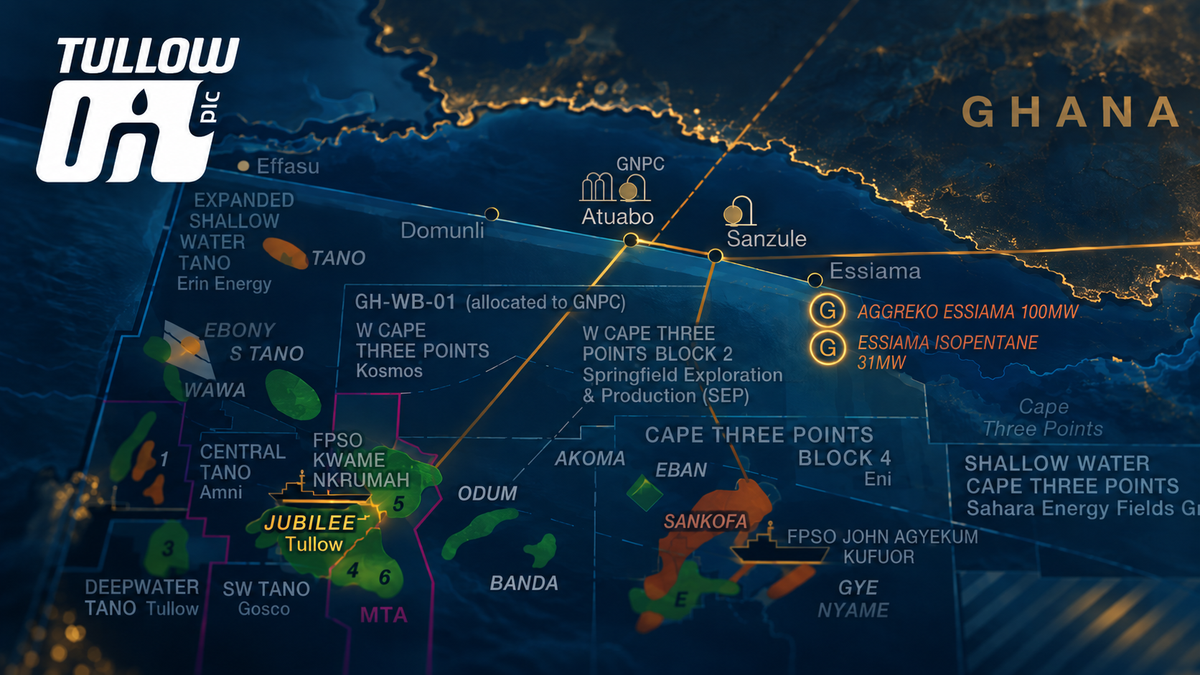
On Monday, Tullow Oil reported one of its strongest operational updates for some time. Production had risen, new Jubilee wells were performing well, FPSO uptime was above 99%, and Tullow management estimated 2P reserves at 121.7 million barrels of oil equivalent at 30 June. Full-year free cash flow guidance of $170–250 million, upgraded in August, was reiterated. Net debt remained high at around $1.4 billion at the end of June, but the operating story appeared to be improving. Investors that bought into that news had a horrible shock waiting for them.
Two days later, the shares lost half their value in a single session. The trigger was not an unexpected reservoir problem, a failed well or an FPSO shutdown. An ICC tribunal ruled against Tullow over a $196.5 million Ghanaian corporate income tax assessment relating to business interruption insurance proceeds. It also ruled that penalties assessed at 100% fell outside the contractual protections on which Tullow had relied. Tullow had already made provision for an adverse outcome, but not enough.
The collapse in the equity was not caused by deterioration in the operating business. Tullow generated $222 million of underlying operating cash flow in the first six months of 2026 and more than $400 million over the preceding twelve months. Yet a ruling that was adverse by an amount relatively modest compared with the cash-generating capacity of the underlying business wiped out half the equity value in a single day.
Nothing had happened to its oilfields. The reservoirs were the same reservoirs, the wells were still producing and no reserves had disappeared. Tullow is therefore an unusually vivid example of a much broader issue in upstream oil and gas: a company can own producing fields containing substantial reserves and capable of generating significant future cash flow while its equity becomes worth very little.
Understanding how that happens requires separating the economics of the oilfield from the economics of the equity that owns it.
An oilfield and its equity are different investments
There are many ways to value an oilfield. We can forecast production, oil prices, operating costs, tax, future investment and abandonment expenditure, then discount the resulting cash flows. We can model different reserve outcomes, development costs and schedules and argue about the appropriate discount rate. Whatever method we choose, the object we are initially valuing is the asset.
But if we change the financing, instead of shareholders funding the entire development themselves we can introduce debt alongside the equity. Nothing about the underlying oilfield has changed: the reservoir is no better, the wells do not produce more and the development itself has not become more valuable.
What has changed is the way the economic outcome is divided. If the field performs as expected, leverage can make the investment look more attractive to equity because shareholders have committed less capital while retaining whatever value remains after servicing and repaying the debt.
That is one reason borrowing can be so attractive to upstream companies. It can avoid issuing shares at unattractive prices, enable developments that could not otherwise be funded and make larger acquisitions possible. In a successful case, shareholders control a much larger asset base for the same initial equity investment.
But leverage has not increased the value of the barrels. It has changed the claim shareholders have on them. The creditor has a contractual claim and equity owns what remains, which becomes much more important when the outcome differs from the plan.
Upstream projects rarely follow the central case
Oilfield development contains uncertainty almost everywhere. Recoverable reserves can be lower than expected, well productivity can disappoint, water can arrive earlier, developments can cost more than forecast, first production can slip, operating uptime can fall, tax terms can change and commodity prices can be weaker than assumed.
Most of these risks are familiar to upstream executives and investors. Companies routinely publish sensitivities and use probabilistic reservoir models rather than pretending that one deterministic production forecast represents the future. Debt introduces another characteristic because its contractual claims generally do not adjust downwards when the oilfield disappoints.
Take a $3 billion oilfield financed with $1 billion of debt and $2 billion of equity. If the value of the field falls to $2 billion, the lender is still repaid the full $1 billion, but the value attributable to equity falls from $2 billion to $1 billion. A 33% reduction in the value of the asset has produced a 50% reduction in the value of the equity. The contractual debt claim, however, remains $1 billion.
Push the example further. If the field value falls to $1.2 billion, the lender can still recover the full $1 billion, with no haircut to the debt. But only $200 million is left for shareholders. The underlying asset has fallen by 60%, while the equity has lost 90% of its value.
The lender has suffered no loss in either case. The deterioration has been absorbed entirely by the shareholders because equity sits beneath the fixed debt claim.
This matters particularly in upstream because risks can move together. A project delay can increase costs while postponing cash flow, lower production can coincide with lower commodity prices, and weak prices can reduce operating cash flow precisely when refinancing is required. A technical problem that would be manageable for an ungeared company can become a financing problem for a heavily indebted one.
A central-case NPV or equity IRR can therefore give only part of the picture. It may demonstrate how attractive leverage is when the expected outcome occurs, while saying much less about what happens to shareholders across the full range of plausible outcomes. The geology has not changed, but the distribution of gains and losses has.
Cheap debt comes with a different claim
Debt is often described as cheaper than equity. That is correct, but the observation can obscure why.
Depending on the instrument, creditors may receive contractual interest, priority over shareholders, security over assets, defined maturities, restrictions on additional borrowing, limitations on distributions and other protections intended to preserve repayment. Some structures contain financial maintenance covenants; others rely more heavily on security, restrictions, cash sweeps and rights that become important when the borrower's position deteriorates.
A lender therefore does not require the same return as an ordinary shareholder because it is not buying the same exposure. The lower expected return reflects, in part, a better-protected position.
There is another feature of upstream financing that deserves attention. Equity is often present when the risk is greatest. Shareholders may fund exploration when there may be no discovery at all, appraisal before recoverable volumes are well understood, and engineering and early development expenditure before an asset generates cash.
As the project matures, uncertainty falls. A discovery becomes an appraised development, the development becomes a producing field, and production history establishes well performance, reservoir behaviour and operating costs. The asset becomes easier to lend against, which is often precisely when debt becomes easier to introduce.
That is rational behaviour by lenders. They want confidence that their money can be repaid. From the shareholder's perspective, however, equity may have absorbed much of the early uncertainty and helped create an asset sufficiently mature to support secured borrowing. The company then allows a new provider of capital to establish a senior claim against that asset.
The relevant question for the board is therefore not simply whether debt costs less than equity. It is what shareholders receive in return for placing that claim ahead of them and how much flexibility is surrendered in the process.
Debt eventually takes more than interest
When a company is comfortably financed, management can choose projects because they create value, sell assets because somebody is willing to pay an attractive price and return cash because the board considers it surplus to the company's needs.
As financial headroom narrows, the questions change. Projects may be deferred to preserve liquidity, assets may be sold because leverage has to fall, cash that might have been distributed can be swept into debt repayment, and refinancing can become one of the company's overriding priorities.
Commodity hedging provides a straightforward upstream example. A lender may want a producer to hedge part of future production so that enough cash flow is protected to service debt if prices fall. From the creditor's perspective that can be entirely rational because it narrows the range of outcomes around repayment.
The hedge has two sides. If oil prices rise sharply, some of the upside that would otherwise have accrued to ordinary shareholders has been surrendered. Financing can therefore change not only the downside risk of the equity but its participation in the positive tail.
Tullow's current financing structure shows how far the relationship between financing and corporate freedom can develop, but the refinancing should not be confused with the decisions and events that created the need for it. By the middle of 2025, Tullow itself said that successful refinancing of roughly $1.3 billion of notes due in May 2026 was fundamental to its going-concern assessment. It warned that failure to refinance could ultimately lead to insolvency proceedings that the directors believed would probably return limited or no value to shareholders.
By the time the 2026 refinancing was negotiated, Tullow therefore needed a solution to obligations that already existed. The bondholders and Glencore did not create that starting position; they negotiated with a borrower whose alternatives had become constrained.
Around $1.185 billion of new senior secured notes were issued to existing noteholders at completion, alongside another $25 million of those notes issued to Glencore. They carry 10.25% cash interest, 3% payment-in-kind interest and a further 1.75% pay-if-you-can component. The structure also contains cash sweeps, and Tullow subsequently repaid about $48 million of the senior notes in June.
Glencore received approximately $423 million of junior secured notes carrying interest at SOFR plus 12.75%, paid in kind, with another 0.75 percentage points of PIK interest when the relevant Brent assessment exceeds $65 a barrel. The refinancing also created a revolving cargo prepayment facility of up to $100 million from Glencore, drawn against designated Jubilee and TEN cargoes.
The creditor protections extend beyond interest and repayment. The refinancing retained and enhanced an all-asset security package and included governance and value-maximisation provisions, including the appointment of independent directors from creditor-provided lists, a board-level committee overseeing the value-maximisation process and independent oversight of annual budgets. Tullow stated that these arrangements would not affect day-to-day operatorship or joint-venture decision-making.
Those are strong protections, but they reflect the position Tullow had reached. Once refinancing becomes essential rather than optional, the balance of negotiating power is very different from the position of a company choosing among several sources of capital.
Glencore's relationship with Tullow also extends beyond lending. When its original $400 million facility was agreed in 2023, the parties simultaneously entered oil marketing and offtake arrangements covering Tullow's crude entitlements from Jubilee and TEN, as well as its then-Gabon interests. The current cargo-prepayment facility continues to operate against designated Jubilee and TEN cargoes.
That is consistent with the way commodity traders can operate. They may provide capital while also securing access to physical flows and associated commercial opportunities. For shareholders, the relevant issue is not whether such an arrangement is improper, but that its economics extend beyond the headline interest rate.
As leverage rises, debt can therefore move from being one source of finance among several to becoming something that shapes the company's choices. More cash flow, management attention and strategic flexibility can become directed towards maintaining the financial structure.
Different providers of capital want different things
None of this requires bad behaviour. The participants simply have different claims on the outcome.
A lender wants its principal returned with the agreed return. A commodity trader may want both a financing return and access to physical volumes. An investment bank arranging financing is paid for completing a financing transaction. Management may want enough capital to undertake a development or acquisition. Shareholders own whatever value remains after claims ahead of them have been satisfied.
Those interests overlap, but they are not identical. This becomes particularly important when the availability of financing begins to substitute for the harder question of whether the complete financing structure is attractive for the owners of the equity.
There is also a difference in organisation. The equity of a listed E&P can be held by thousands of shareholders with different horizons and objectives, while creditors can be much more concentrated. Their rights are contractual, and they can have security, reporting requirements and formal mechanisms for negotiating collectively when circumstances deteriorate.
Shareholders can therefore remain the legal owners of the company while creditors acquire increasing practical influence over what it does. That can happen long before insolvency simply because management knows that future strategic choices have to fit within the financing structure.
For a board, the question "can we finance this?" is therefore inadequate. A financing can be available and still leave shareholders with a poor bargain, just as demonstrating that an acquisition is accretive or that expected equity IRR rises with leverage tells only part of the story.
The better questions concern the full range of outcomes. How much additional value does the borrowing allow the company to create, and how much greater is the probability of serious equity impairment? At what point do distributions stop, an asset sale become necessary or refinancing start dictating strategy? What happens if two or three ordinary upstream disappointments occur at the same time?
Those are equity questions rather than credit questions. They require the board to look beyond the stated cost of debt and consider what the financing does to shareholders under conditions that are less favourable than the central case.
The underlying assets can remain valuable
Tullow's present equity value should not automatically be treated as evidence that its underlying Ghanaian assets have little value. On 28 September, the company reported 43.7 kboepd of first-half working-interest production, more than 99% FPSO uptime and 121.7 mmboe of 2P reserves at 30 June based on management estimates. It also reiterated full-year free cash flow guidance of $170–250 million across a $70–100 per barrel oil-price range.
Those are physical and operating facts. The quoted equity tells us something different: what the market is currently prepared to pay for the residual shareholder claim after considering the financial structure, tax exposures and other obligations sitting ahead of it.
Enterprise value does not resolve that simply by adding debt back to market capitalisation. It is a useful financial metric, but it should not automatically be treated as an independent appraisal of what the underlying oilfields would be worth in another ownership and financing structure.
An asset can have considerable value while very little of that value remains attributable to the equity of the company that owns it. A barrel figure derived mechanically from enterprise value can therefore confuse the value of the petroleum with the consequences of the capital structure wrapped around it.
The arbitration ruling made that difference unusually visible. The oil had not moved and the operating update was only two days old, but another substantial claim had appeared against a company where the shareholder cushion was already thin. The resulting movement in the equity was far larger than the change in the underlying petroleum business.
Boards should model the equity as carefully as the reservoir
Oil and gas companies have become increasingly sophisticated in modelling subsurface uncertainty. They consider multiple geological realisations, alternative development plans, production profiles and commodity-price sensitivities rather than relying entirely on one central case.
Financing deserves the same treatment. A board considering debt for a major project should not stop after showing that the project has a positive NPV, that the borrowing cost is below the expected project return or that leverage increases the central-case equity IRR.
Different capital structures can instead be tested across the same range of project outcomes. The analysis can measure when distributions become vulnerable, when the next project can no longer be funded, when an asset sale becomes necessary, when fresh equity might have to be raised into a weak market and when creditor protections begin to constrain strategy.
It can also measure what is surrendered in favourable outcomes. Interest, PIK claims, mandatory repayments, hedging and other protections all affect how much of the upside ultimately reaches ordinary shareholders.
Debt clearly has a place in upstream finance. Producing assets with relatively predictable cash flows can support borrowing, and debt can prevent unnecessary dilution or enable developments that equity alone could not finance. The appropriate amount, however, cannot be determined from the central case alone.
The more useful test is what happens to the equity when several entirely ordinary upstream risks occur together. Tullow's oilfields have not disappeared and its operating performance may continue to improve, but the events of this week show how thin the shareholder claim can become after enough fixed claims have accumulated above it.
Debt can allow shareholders to control a larger portfolio of oilfields than equity alone would support. Taken too far, it can leave the company operating valuable assets while very little of their economic value remains available to the ordinary shareholders who still legally own it.