The Globalisation of Gas

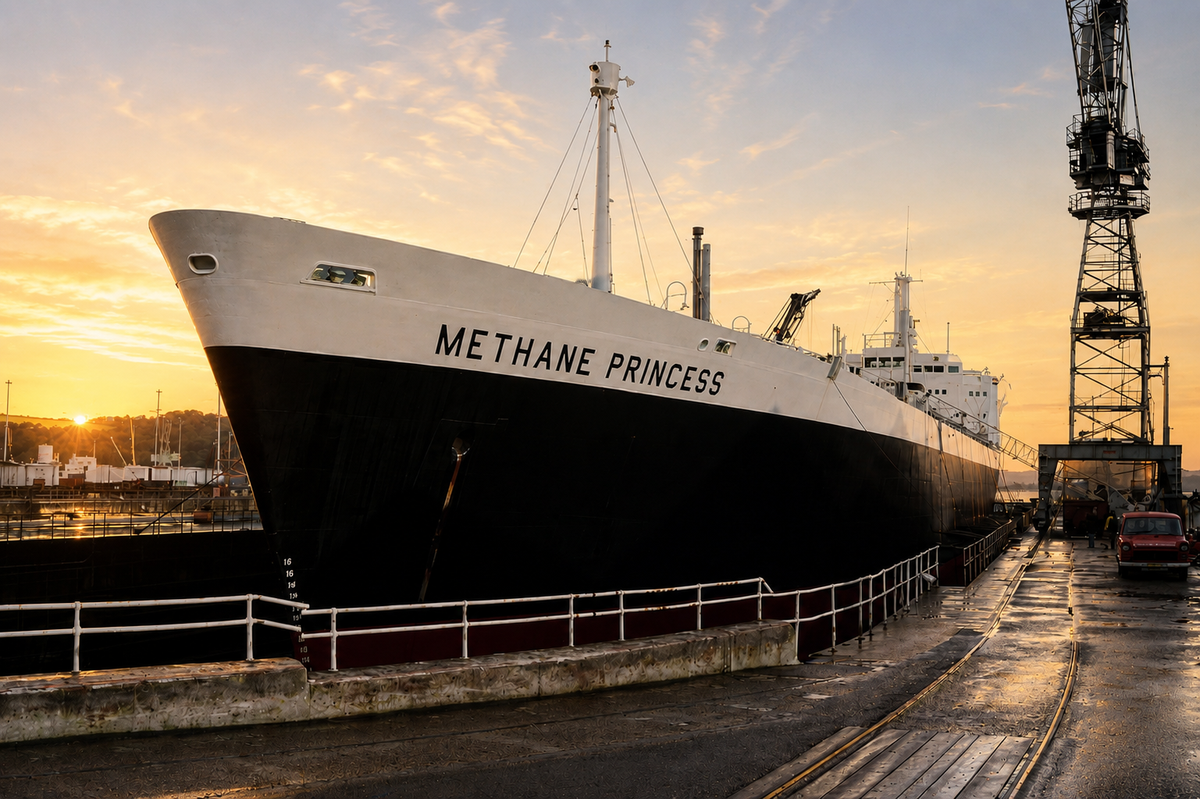
On 12 October 1964, a ship called Methane Princess sailed up the Thames Estuary and berthed at Canvey Island, a low-lying stretch of reclaimed marshland better known for sea walls and mudflats than making energy history.
She had sailed from Arzew, Algeria, with a cargo of liquefied natural gas. It was the first commercial LNG cargo ever delivered anywhere in the world. The voyage took six days, but its significance would take sixty years to become clearer.
By cooling gas into liquid form, producers could finally move it across oceans. In theory, this meant gas could become global in the way oil had always been. In practice, adoption of the technology was slow.
Existing gas markets, or energy alternatives, were already established. The technology was impressive, but expensive. Liquefaction plants were complex. Shipping was specialised. Receiving terminals had to be built at the other end. There was no global spot market to trade it. Buyers preferred long-term contracts because they needed security of supply. Sellers needed the same contracts because LNG projects cost billions.
By the 1990s, things were beginning to move along. Asian demand was growing. Japan, South Korea and Taiwan were showing that LNG could underpin large intercontinental gas markets, while industrialising economies in Southeast Asia were creating the next wave of demand. By the late 1990s and into the 2000s, new projects were being developed in places such as Qatar, Australia and Malaysia. The industry remained in oil’s shadow, but it was no longer experimental.
One company in particular began to pay close attention to these developments. Shell had started to notice something that many others regarded as a curiosity rather than a trend: LNG was changing the commercial nature of gas itself.
For most of the previous century, gas had been fundamentally local. Its value depended heavily on where it was discovered. A giant gas field in the wrong location could be worthless. A gas discovery next to a population centre would be valuable, but this was less common. LNG’s continued expansion began to loosen those historic constraints and it meant explorationists began reviewing regional play maps everywhere.
At first, change was subtle. Cargoes were still sold under long-term contracts and markets remained fragmented. Importantly, gas could not be considered a true commodity as prices continued to vary enormously between regions. But with each new liquefaction plant, import terminal and LNG carrier, gas became a little more mobile, and with that mobility came increased significance.
A cargo originally intended for one customer could be redirected mid-ocean to another. Buyers gained flexibility. Sellers gained market access. Gas was beginning to acquire the trait that had always made oil so commercially powerful: it could move. Geography still mattered, but less than before. Slowly, gas was evolving from a regional fuel into a globally traded commodity.
That insight would have huge implications, shaping Shell’s strategy for the next two decades. The company was not betting on LNG demand growth. It was betting that gas was evolving from a regional fuel into a traded commodity, and it set about becoming king amongst its major peers in global LNG.
The winners would not necessarily be the companies with the largest gas fields. They would be the companies controlling the largest networks of liquefaction plants, shipping capacity, customer relationships and trading operations. Shell spent years assembling exactly that position, while much of the industry remained focused on upstream resource ownership.
Shell was right about the direction of travel. Most of the industry saw LNG projects. Shell saw a future global LNG market. Its prescience was correct, but it could neither see nor control what was coming next: a series of events that would transform global energy markets and repeatedly strengthen LNG’s hand.
The shale revolution was supposed to be an oil story. It changed the balance of power in global crude, weakened OPEC’s grip, turned the United States into the world’s largest source of oil production growth, and forced every major oil company to decide whether it wanted to compete in a faster, shorter-cycle American resource game. Shell was not for turning. LNG was its bet, so in 2021 it agreed to sell its Permian business to ConocoPhillips for $9.5 billion, transferring all of its interest in the basin. Yet the shale revolution in the US, and increasingly elsewhere, would become one of the most important chapters in LNG’s role in globalising gas as a commodity.
Across North America, shale unlocked extraordinary quantities of gas as producers drilling for light shale oil found themselves unavoidably producing huge volumes of associated gas. Domestic supply surged. Natural gas prices crashed. In some regions, gas became almost a disposal problem. Gas that only a generation earlier would have been celebrated as a discovery was now being produced faster than domestic markets could absorb it.
The export build-out came quickly. Cheniere’s Sabine Pass in Louisiana shipped the first LNG cargo from the Lower 48 in 2016. Cove Point in Maryland followed in 2018. Cheniere’s Corpus Christi project in Texas, Cameron LNG in Louisiana, Freeport LNG in Texas and Elba Island in Georgia all joined the export fleet around the end of the decade. Venture Global’s Calcasieu Pass then added another wave in Louisiana, and Golden Pass, backed by QatarEnergy and ExxonMobil, sent its first cargo from Texas in 2026.
LNG changed the commercial picture completely. Cheap American gas suddenly had a route to premium markets. Molecules that might once have struggled to find a home could be liquefied on the Gulf Coast and sold into Europe or Asia. What looked like oversupply became feedstock. What looked like a regional pricing problem became a global trading opportunity. The shale revolution ended up doing something few anticipated, including Shell. It created cheap, bountiful raw material for the next phase of LNG’s growth. OECD, Atlantic and Pacific producer growth.
It also familiarised a new generation of energy companies with LNG. Developers, producers, pipeline operators and integrated majors increasingly found themselves thinking about liquefaction capacity, shipping economics, Asian demand growth and European gas balances. Global LNG was no longer the specialist domain of Shell; it was becoming the focus of some potentially formidable competitors.
At roughly the same time, another trend was gathering momentum. The energy transition was expected to be a challenge for hydrocarbons. In many respects it was. Yet it also strengthened the strategic position of gas. Coal-fired generation came under increasing pressure across developed economies. Governments wanted lower emissions but still needed reliable power. Gas increasingly occupied the middle ground. Cleaner than coal, flexible enough to support intermittent renewable generation and backed by an expanding global supply chain, it became the preferred bridge fuel for much of the world. LNG benefited accordingly.
Importing nations that had previously lacked access to pipeline gas could now participate in global gas markets. Emerging economies seeking cleaner fuels could switch away from coal. New buyers entered the market. Existing buyers expanded their requirements. The industry that had spent decades trying to create demand increasingly found demand arriving on its own. By this point, Shell was no longer alone.
TotalEnergies was assembling a formidable LNG position of its own. Qatar continued expanding production from the North Field. ExxonMobil, despite being later to embrace LNG as a strategic priority, was increasing its exposure through Qatar and Papua New Guinea before eventually backing major US export capacity. The race was no longer about proving LNG worked. It was about securing position.
Then came Russia. For decades, Europe had relied upon Russian pipeline gas. The arrangement was so embedded that many policymakers treated it as permanent. Energy security had become a theoretical discussion rather than a practical concern. That assumption collapsed when Russia invaded Ukraine.
As Russian pipeline volumes disappeared from Europe, LNG stepped into the gap. Import terminals were commissioned at unprecedented pace. Governments that had spent years debating decarbonisation suddenly found themselves focused on security of supply. Buyers rushed to secure long-term contracts. Sellers found themselves in a position of strength. For the LNG industry, it was a transformational moment.
The thesis Shell had identified decades earlier was no longer a theory. Gas had become global. Cargoes moved to whichever market valued them most. LNG was no longer simply an energy commodity. It had become a strategic commodity.
Then, just as markets were becoming comfortable with that reality, came another reminder. The concentration of global LNG supply in the Gulf had always been understood. What had been less appreciated was how exposed the market remained to geopolitical disruption. Tensions involving Iran and concerns surrounding the Strait of Hormuz reinforced the same lesson Europe had just learned from Russia: security of supply matters.
Suddenly diversity of supply carried a premium. Buyers wanted optionality. Governments wanted flexibility. Energy security once again became a boardroom topic. LNG had spent decades trying to become more like oil: mobile, tradable and global. Now it was becoming like oil in another sense. Where it came from, who controlled it, and which routes it travelled through were becoming matters of huge geopolitical importance.
The shale revolution made gas abundant. The energy transition made gas acceptable. Russia made gas strategic. Iran made gas geopolitical. Taken together, they created conditions that even those few forward-thinking Shell executives in the 1990s could never have imagined.
For years Shell occupied a relatively lonely and quiet position, which would have suited nicely. It invested heavily in LNG while many competitors remained focused on oil, conventional gas or, later, the shale revolution. Today the landscape looks very different. New export projects continue to emerge rapidly, and now everyone has to pay attention because ExxonMobil is talking about getting seriously involved.
In many ways, Exxon is using the consequences of the shale revolution to pursue the opportunity Shell identified decades ago. The irony is difficult to miss. Shell sold its Permian position because it remained convinced LNG was the bigger prize. Exxon stayed, harvested the cash flow and is now using that to accelerate its own LNG ambitions and compete with Shell.
Shell's great strategic achievement was recognising before almost anyone else the revolution LNG would bring to global energy markets. Whether it can translate that foresight into enduring strategic advantage is becoming increasingly doubtful.