If BP Sells UK Upstream, Equity May Matter More Than Cash

The final phase of UK North Sea consolidation is surely approaching fast.
BP has reportedly been reviewing its UK North Sea upstream business as part of a broader portfolio reset. BP’s UK upstream business is special because it is not just a run-off package. A large part of the UK North Sea’s remaining strategic value sits West of Shetland, and BP has dominated that region from the start. It is, by far, the least mature part of the UKCS and still has huge remaining potential, especially in the hands of one of the emerging UK mid-cap players.
How this could play out
First, transaction strategy, because that will determine what kind of deal is possible.
A buyer will argue that the upside comes from its own operating model: lower costs, sharper capital allocation, infrastructure strategy, field-life extension, tie-back opportunities and basin focus. BP may argue that those opportunities are embedded in the asset package and should therefore be fully reflected in the sale price.
That tension is central to any negotiation, and the cleanest way to bridge it is deal structuring.
BP can seek upfront value based on the buyer’s higher valuation case. If the buyer believes it can work the assets harder, create more value and build a better platform around them, that belief should support the price it is prepared to pay. But BP can also take equity in the buyer, and that equity component matters for three reasons.
First, equity validates the valuation. A buyer of BP UK upstream would likely need to justify the transaction to its own shareholders and the lending banks being asked to provide debt. If the price is based partly on the buyer’s own plan, rather than BP’s base case, investors may ask whether the buyer is overpaying. BP taking shares helps answer that question. It signals that BP is not simply extracting the highest possible cash price and walking away. BP is agreeing to own the enlarged company and share in the same execution risk as the buyer’s shareholders. That can make a higher valuation easier to defend.
Second, equity increases competitive tension. A pure cash transaction favours the largest buyers. It narrows the field to those with the balance-sheet capacity to write the biggest cheque. Equity as part of the consideration changes that because it allows smaller but strategically aligned buyers to enter the process, with part of the consideration paid in paper rather than cash. That is particularly relevant if BP wants a buyer whose existing business is closely tied to the assets being sold, rather than simply the buyer with the largest market capitalisation. More credible bidders mean more competitive tension, and more competitive tension should improve BP’s ability to capture value.
Third, equity preserves residual upside to the seller. Even if a buyer’s valuation reflects its base plan, the more speculative upside will still be heavily risked: additional tie-backs, field-life extension, infrastructure optimisation, future resource conversion, fiscal improvement, or a market re-rating of the enlarged platform. BP may not get paid fully upfront for all of that. Equity lets BP keep exposure. If the buyer works the assets harder, proves up the upside, builds a stronger platform and earns a higher valuation, BP participates through the shares it receives.
This is why equity is not just a financing tool. BP can receive cash based on the buyer’s valuation case, validate that case through retained equity, provide comfort to the buyer’s shareholders and lending banks, widen the buyer universe, and keep exposure to speculative upside that has not yet been captured.
There are other benefits for BP too. A sale would move liabilities, cost base and future capital commitments off BP’s balance sheet. It would reduce management attention on assets that may no longer be core. And, where commercially relevant, BP may still retain attractive commercial exposure to the sold barrels through offtake or related arrangements.
The core mechanism is simple: sell the asset, price it against the buyer’s plan, take cash for part of the value, take equity for validation and upside, and let the focused owner work the assets harder, at least in part, on your behalf.
The Aker BP benchmark
BP has used a version of this before, and in very similar circumstances: in Norway, a close neighbour to the UK North Sea.
BP did not simply sell BP Norge for cash and disappear. Det norske acquired BP Norge, issued new shares to BP as consideration, and the enlarged company became Aker BP. Aker, already a major shareholder in Det norske, ended up with around 40% through the transaction mechanism, BP around 30%, and other Det norske shareholders around 30%.
That plan worked, and worked well. Looking at the implied valuation at the time versus the value BP ultimately realised through the cash-plus-equity arrangement, BP achieved a multiple of what it would likely have received from a cash-only exit. That should be the benchmark for thinking about BP UK upstream.
The recent talks
Reports that BP held advanced talks to sell its UK North Sea business for around £2 billion show that this discussion is not theoretical. Those talks have reportedly fallen through, but BP is still said to be open to similar deals with other potential buyers. That does not undermine the consolidation thesis. It may simply show that the structure is sometimes challenging.
A transaction of this size is not a normal asset sale. It would involve production, reserves, infrastructure, tax attributes, decommissioning, capital commitments, commodity price exposure and political risk. And for BP, reputational risk. Price would matter. But the form of consideration may matter just as much: how much cash, how much acquisition debt, how much deferred or contingent consideration, and how much buyer equity?
And if equity is part of the consideration, the question becomes sharper: whose shares would BP actually want to own?
The buyer universe
This is where Harbour, Serica, Ithaca and the private platforms each become interesting for different reasons.
Harbour has the strongest paper. Serica has the most interesting equity-currency story. Ithaca is relevant because it was the reported counterparty in the recent BP talks, and because the breakdown of those talks may tell us something important about structure.
The right answer depends on what BP values most: liquidity, direct asset alignment, shareholder approval dynamics, competitive tension, residual upside to a focused UKCS platform, reputational risk and strategic fit.
Harbour: strongest paper, different exposure
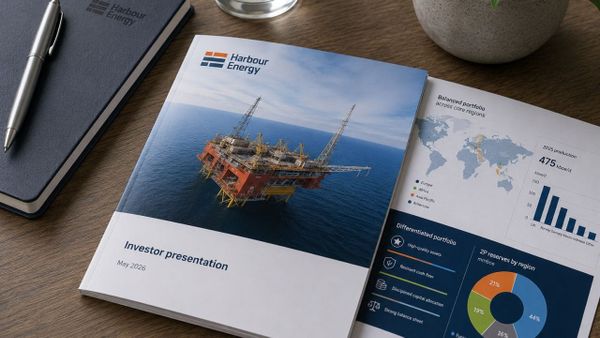
Harbour has the strongest paper in capital markets terms. It is larger, more liquid, more institutionally recognised and has already shown it is willing to use M&A to reshape the business. If BP prioritised liquidity and future sell-down flexibility, Harbour would have obvious attractions.
But the exposure is different. Harbour is no longer a pure UKCS story. Since the Wintershall Dea transaction, it has become a broader international E&P. That may be positive for Harbour shareholders, but it means BP would be exchanging UK upstream ownership for exposure to a diversified global portfolio. Harbour gives BP better paper, but less direct UKCS alignment.
I have previously wondered whether Harbour needs to deepen its institutional shareholder base in any event; a transaction of this scale could help by bringing BP onto the register and giving larger institutions a clearer reason to revisit its equity story.
Ithaca: useful precedent, not necessarily the answer
Ithaca still needs to be mentioned because it was the reported counterparty in the recent BP talks. It has scale, Main Market status, UKCS focus and meaningful West of Shetland exposure. But the fact those talks have reportedly fallen through means it would be too neat to present Ithaca as the obvious answer.
The more useful point is that Ithaca shows how hard this kind of deal is to structure. Delek already controls the company and may want it to stay that way. A meaningful BP equity component could introduce a second strategic shareholder, dilute Delek, alter the free float and raise governance questions around board rights, relationship agreements, lock-ups and future sell-downs.
The asset logic may have been strong. The structure may have been harder. Failed talks do not necessarily disprove the consolidation thesis. They may simply show that the next UKCS transaction needs more careful structuring than a simple buyer-seller negotiation.
Serica: the more interesting equity-currency question
Serica is the less obvious buyer by size, but the more interesting buyer by equity-currency development. On today’s market capitalisation, a near-£2 billion transaction would be transformational. Any meaningful BP equity component would be very large relative to Serica’s current value. That is the problem, but it is also the opportunity.
Serica has been building towards a larger UKCS platform. It has moved further into West of Shetland, increased its production base through acquisitions, introduced a clearer dividend framework, and is targeting a move from AIM to the Main Market later this year.
That listing move may matter most as an M&A enabler. AIM equity is not an easy currency for a major seller to accept in size. It is less liquid, less institutionally owned and harder for some investors to hold. Main Market equity is more credible. FTSE 250 equity would be more credible again.
If Serica successfully broadens its shareholder base and improves liquidity, its shares become more useful. Not just for investors. For sellers. That is the angle: Serica may be trying to turn itself from an AIM-listed E&P into a listed UKCS consolidation vehicle whose equity can be accepted in larger deals.
A Serica-led transaction would need more moving parts than a deal with a larger buyer. The simplest form — Serica paying a large amount of cash and issuing a very large block of shares to BP — would be difficult to absorb. A more realistic structure would probably reduce the equity issued directly to BP, increase the role of institutional capital, and widen the financing base.
That could mean a higher cash component, acquisition debt sized against the acquired assets, some BP equity consideration, and potentially deferred or contingent consideration. It could also mean bringing in other institutional investors alongside the transaction, rather than asking existing Serica shareholders and BP to carry the full equity burden, something a Main Market listing should help with.
Mercuria’s position is relevant too. As Serica’s largest shareholder, Mercuria would be diluted by a large equity issue unless it participated. It may also be able to support the transaction through debt or structured financing, as it has done elsewhere before. Alternatively, if its shareholding were not viewed as a constraint, Mercuria could participate in an equity raise to maintain its position, or at least reduce dilution. Aker BP has shown strong shareholders are required to complete this kind of transaction. Usually these large shareholders reduce their exposure over time; few will want their cash tied up indefinitely, especially if the value proposition materialises anyway.
There are many ways to structure the problem. The important point is that a Serica transaction does not have to mean BP receives an unmanageably large stake. It could be structured with multiple sources of capital, a smaller BP equity component, and a more digestible ownership outcome.
That would still be difficult. But if Serica is Main Market listed, FTSE 250 eligible or included, and backed by a wider institutional register, it becomes much less fanciful.
The private-platform option
There is another possibility.
BP’s buyer universe should also include the large private UKCS platforms: Adura and NEO NEXT+. These vehicles were created by combining major-owned UK upstream businesses with existing North Sea platforms or ownership structures, leaving the selling majors with ongoing equity exposure in enlarged independent companies.
That already looks close to the Aker BP mechanism.
A private platform may offer BP a different route: roll its UK upstream business into a larger private consolidator, receive straight equity in the enlarged vehicle, and retain exposure to a platform that could be listed later when fiscal and market conditions are more supportive. In that structure, BP would not be taking listed paper on day one. It would be taking equity in a vehicle designed to become liquid eventually, without forcing an IPO while UK fiscal uncertainty is still depressing valuations.
Timing is an important consideration. An IPO today would risk forcing too much fiscal uncertainty into the valuation. A delayed listing could be more attractive: consolidate the assets now, build the platform privately, wait for greater clarity on the post-EPL regime, and then come to market when investors can underwrite the cash flows with more confidence.
It would also broaden competitive tension beyond Harbour, Serica and Ithaca. A private-platform route could allow BP to negotiate not only around price, but around the future shape of the UKCS consolidation vehicle itself.
The investment implication
The BP talks may have stopped for now, but they have exposed the shape of the next debate. West of Shetland is not just another late-cycle North Sea package. It is one of the few parts of the UKCS where scale, infrastructure and future resource potential still matter in a meaningful way.
If BP sells for cash, the buyer universe is about funding capacity. If BP takes equity, the buyer universe is about platform quality. That is a very different lens.
It also makes Serica’s Main Market move more important than it first appears. The move is not simply about prestige, governance or index eligibility. It may be about creating paper that a major seller could plausibly accept.
Harbour remains the strongest capital markets paper. Ithaca remains important because the reported talks show both the strategic logic and the structuring difficulty. Serica may be the most interesting listed investment angle, because the value of its listing move could be tested not just by investors buying the stock, but by whether sellers are willing to take it.
The private platforms add another dimension. If BP is willing to accept equity in a vehicle that is not yet listed, the question becomes whether Adura or NEO NEXT+ could become the UKCS consolidation platform that ultimately comes to the public market.
If Aker BP is the precedent, the question is not whether BP can sell UK upstream. It is whether the UK has a consolidation platform — listed today or IPO-able tomorrow — whose equity BP would want to own.
And if West of Shetland is the prize, that question matters more than ever. It may be the UK North Sea’s last great consolidation prize.