How Oxy Monetised California Without a Buyer
Occidental Petroleum's 2014 spin-off of California Resources Corporation was more than a corporate separation. It was a high-stakes capital allocation decision that unlocked value for some shareholders, transferred risk to others and exposed the dangers of leverage in a cyclical industry.

🎧 Prefer to listen?
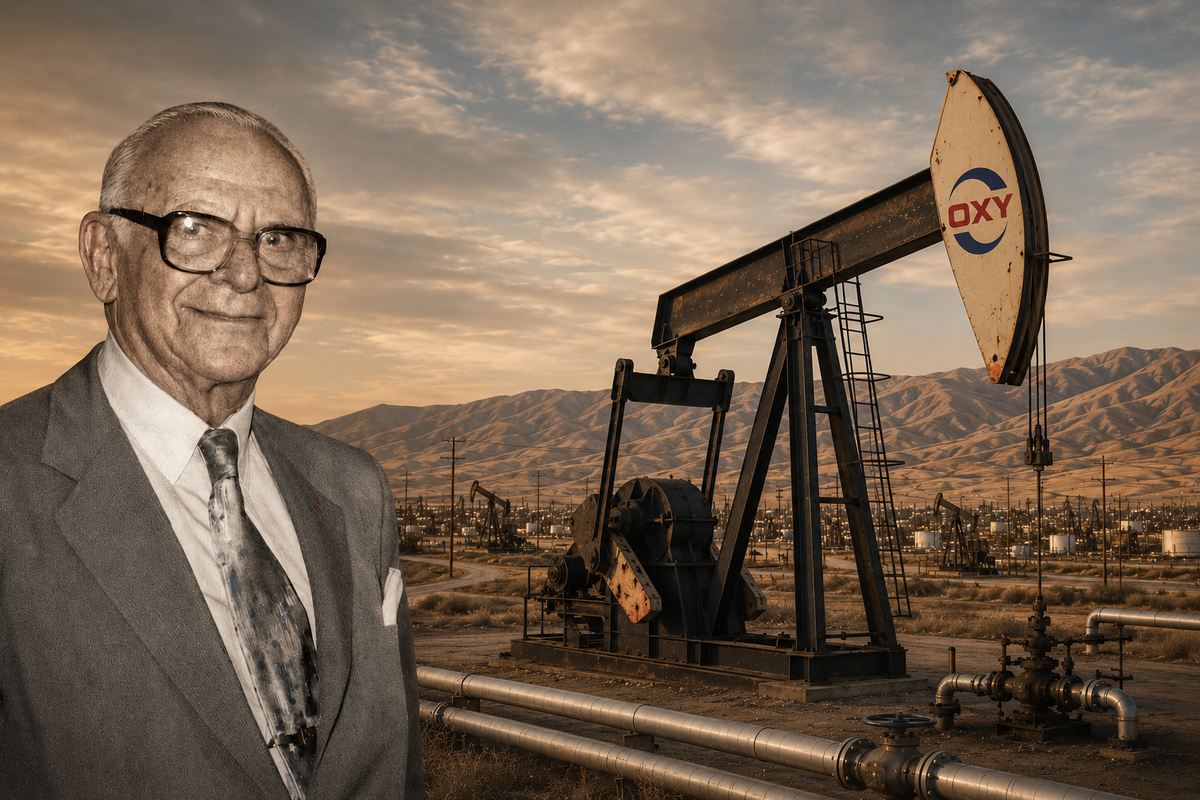
Occidental Petroleum was incorporated in Los Angeles in 1920, but the company that eventually became known around the world as Oxy was really the creation of Armand Hammer.
Hammer trained as a doctor, made money in pharmaceuticals and spent much of the 1920s conducting business in the Soviet Union, where he developed relationships that would make him one of the most unusual corporate figures of the twentieth century. By the time he settled in California in the 1950s, he was already an entrepreneur, trader, art collector and political intermediary rather than an oilman in the traditional sense.
Occidental was then a small and precarious California oil company. Hammer became involved through an investment, acquired control and was elected president and chief executive in the late 1950s. One account by an early Oxy geologist described the company as close to defunct in 1959, producing only around 100 barrels a day and operating from a small metal office in the sunburned Bakersfield oil patch.
Oxy’s first successes came in 1961 when, after several worrying dry holes, its geologists found gas in the Sacramento Valley and developed a sequence of productive wells around the Arbuckle field. The discoveries were not enormous by the standards of the international oil industry, but they gave the fragile company production, credibility and the confidence to look beyond the state. California was therefore more than just one part of what Oxy would eventually become. It became part of the company’s folklore: the place where Hammer learned how to be an oil digger.
Hammer’s great skill was not that he became the most technically accomplished oil executive of his generation. It was his appetite for transactions, relationships and risks that larger or more conventional companies were reluctant to take. He understood how political access, commercial ingenuity and a willingness to move quickly could allow a small company to compete with businesses many times its size.
After seeing the company’s early California gas wells, Hammer asked one of his geologists where he would explore if he could operate anywhere in the world. The answer was Libya, where the major international oil companies had already made large discoveries but were preparing to relinquish acreage that they had not fully explored. Oxy established a Libyan subsidiary in 1963 and successfully bid for two concessions in 1965, despite having little international operating experience and far less geological data than the established majors.
Oxy drilled its first Libyan exploration well in 1966. The discovery on Concession 102 tested at almost 15,000 barrels a day and opened what became the Augila field, then one of the largest discoveries made in Libya. Further discoveries followed. By the summer of 1969, Oxy’s Libyan operations were producing around 800,000 barrels a day, making the former Bakersfield minnow one of the largest oil producers in the world.
The speed of the transformation was extraordinary. A company producing roughly 100 barrels a day in 1959 had, within a decade, built an international operation producing hundreds of thousands of barrels a day. California had provided the starting point; Libya created the scale. It also established a corporate character that survived Hammer. Oxy was not built in the orderly manner of the descendants of Standard Oil, with integrated refining, distribution and retail systems accumulated over generations. It was built through exploration bets, acquisitions, political relationships and the repeated willingness to move into situations where established companies saw too much uncertainty.
The company then expanded rapidly beyond oil and gas. In 1968, it acquired Hooker Chemical, creating the foundation of the chemicals business that would eventually become OxyChem. In 1982, it bought Cities Service for around $4 billion, one of the largest corporate transactions undertaken in the United States at the time. The acquisition substantially enlarged Oxy’s domestic oil and gas position, although the company subsequently sold much of the refining and marketing business that came with it.
Hammer’s Oxy became a conglomerate as much as an oil company. At various times it owned coal, chemicals, pipelines, agricultural businesses, meat processing and other industrial interests alongside its oil and gas operations. Some acquisitions created lasting strategic positions. Others added complexity, debt or liabilities that later management teams had to resolve.
When Hammer died in 1990, Occidental was therefore a very different company from the small California producer he had taken over three decades earlier. It had become an international oil business with interests across several continents, a major chemicals operation and a collection of other industrial assets assembled through years of acquisitions. What it lacked was the cleaner strategic identity that investors would later expect from a large listed oil company.
Ray Irani, who succeeded Hammer, spent much of the following two decades reshaping that inheritance. Oxy disposed of peripheral businesses, reduced its conglomerate character and concentrated increasingly on oil and gas, chemicals and the infrastructure that supported them. This was not a single restructuring completed at one moment, but a long process of deciding which parts of Hammer’s empire still belonged together and which no longer justified their place within the group.
OxyChem survived because it remained a substantial and profitable business in its own right. The upstream portfolio was rebuilt around regions where Oxy believed it possessed scale, technical knowledge or relationships that could not easily be replicated. The company expanded in the Permian Basin, where it became a major conventional producer and one of the leading practitioners of carbon-dioxide enhanced oil recovery. Internationally, it retained and developed long-life positions across the Middle East and North Africa, particularly in Oman, Qatar and the United Arab Emirates, while maintaining operations in countries including Colombia.
California was not neglected during this period. On the contrary, Oxy made one of the largest investments in the state’s oil industry after Hammer’s death. In 1997, it agreed to pay $3.65 billion for the federal government’s 78 per cent interest in the Elk Hills Naval Petroleum Reserve near Bakersfield. The acquisition, completed the following year, was described at the time as the largest privatisation of US federal property and gave Oxy control of one of California’s most important oil and gas fields.
Elk Hills became the centrepiece of Oxy’s California operations. It brought large reserves and production, but also gas processing, power generation, pipelines, land and extensive subsurface knowledge. Together with Oxy’s positions elsewhere in the San Joaquin, Los Angeles, Ventura and Sacramento basins, it helped turn California into a business of sufficient scale to stand alongside the company’s other principal operating regions.
California was therefore both the place where Oxy had first established itself as an operator and, decades later, the focus of one of its largest strategic investments.
By the beginning of the 2010s, Oxy’s centre of gravity was shifting again. Its large, connected position in the Permian Basin of West Texas and New Mexico combined mature conventional production, extensive carbon-dioxide infrastructure and a growing unconventional resource opportunity. The Middle Eastern assets offered long-life production and relationships accumulated over decades, while OxyChem provided a substantial earnings stream outside upstream oil and gas.
Oxy entered 2013 as a large but unusual international oil company. It was not an integrated major in the ExxonMobil or Chevron mould and did not own a global refining and retail system. Instead, it consisted of major upstream positions in the United States, the Middle East, North Africa and Latin America, alongside OxyChem and infrastructure that supported or enhanced its oil and gas operations. The company remained headquartered in Los Angeles, but much of the business around which its future was being constructed now lay elsewhere.
In 2013, Oxy produced 763,000 barrels of oil equivalent a day, with domestic production accounting for around 60 per cent of the total. Most of the balance came from the Middle East and North Africa, with a smaller contribution from Latin America. California remained one of the company’s largest individual operating regions, producing 154,000 boe/d and holding 744 million boe of proved reserves, around one-fifth of the group total. This was therefore not a marginal collection of unwanted properties. Oxy California was a company-sized operation in its own right, with major fields, extensive infrastructure, a substantial workforce and a reserve base that many independent producers would have regarded as transformative.
California was large, but its character was becoming increasingly distinct from the businesses around which Oxy was reshaping itself. Its fields were mature and required continuous reservoir management, maintenance and investment. Production depended on conventional drilling, waterflooding, steamflooding and other enhanced-recovery techniques. Mature fields can generate substantial cash, particularly when the operator owns infrastructure, understands the reservoirs and can add production incrementally, but they carry a different financial and operating profile from a rapidly growing unconventional position.
The Permian could be presented as both a growth and returns story. It offered a large inventory of drilling opportunities, extensive infrastructure and the ability to accelerate or reduce activity as conditions changed. California offered long reserve life, crude pricing linked more closely to Brent than inland WTI and valuable owned infrastructure, but it also brought a substantial legacy operating footprint and increasingly important long-term retirement obligations.
The future value of the California business depended not only on geology and commodity prices but on confidence that wells could continue to be permitted, developed and operated within a state whose climate and environmental policies were moving away from hydrocarbons faster than those of most other producing regions in the United States. Its land, pipelines, processing plants and power facilities were valuable, but they would eventually require abandonment, remediation or continued monitoring. Infrastructure income was also only as durable as the production volumes supporting it.
The issue was therefore not that California had ceased to be a serious operating business. It was that Oxy had become a company containing several distinct strategic propositions. The Permian offered growth and repeatability, while the Middle East provided long-duration production and relationships built over decades. OxyChem was an established profit centre with its own earnings profile and valuation characteristics. California, by contrast, was a mature, geographically concentrated business whose regulatory trajectory and long-term liability profile investors might increasingly prefer to value separately from the rest of the group.
Those differences became more important as Oxy’s portfolio question became entangled with a wider dispute over how the company was governed and for whose benefit it was being run. During the later Irani years, investor concern extended beyond the performance of individual assets to executive pay, board independence and succession planning. At the 2010 annual meeting, shareholders rejected Oxy’s advisory vote on executive compensation by 54 per cent to 46 per cent. CalSTRS and activist investor Relational Investors subsequently threatened to seek the removal of four of the company’s thirteen directors, criticising both the scale of executive rewards and what they regarded as an entrenched board without a credible succession plan. Oxy responded by reducing prospective incentive awards and confirming that Stephen Chazen would become chief executive in 2011, with Irani moving to executive chairman.
Chazen therefore inherited a large and valuable company, but not a free hand to reshape it. Irani remained executive chairman, retained responsibility for international business development and continued to advise on strategic matters. Oxy was also under pressure to demonstrate that its considerable spending was producing adequate growth and shareholder returns. In early 2013, the company set out plans to cut US drilling costs by 15 per cent, reduce its average US rig count from 64 to 55 and lower planned capital spending to $9.6 billion. By the end of March, Oxy’s shares had fallen 18 per cent over the preceding year, compared with gains of 11 per cent for Chevron and 4 per cent for ExxonMobil. The questions surrounding the portfolio were becoming inseparable from those surrounding leadership, spending discipline and performance.
The disagreement over succession then broke into the open. Reuters reported that Irani was pressing for Chazen to be replaced, while several large investors supportive of Chazen were considering voting Irani and other directors off the board. At the annual meeting on 3 May 2013, Irani did not receive a majority of the votes cast for his re-election and resigned. The board subsequently installed an independent chairman, ending more than two decades in which Irani had exercised enormous influence over Oxy and giving Chazen greater freedom to reconsider both the portfolio and the way the company used its cash.
With Irani gone, the strategic review that followed was more than a routine exercise in tidying the portfolio. Actions announced later in 2013 included plans to reduce Oxy’s exposure to the Middle East and North Africa, pursue alternatives for certain domestic assets and sell part of its interest in Plains All American Pipeline. Proceeds from the initial disposals were being directed towards debt reduction and share repurchases. Oxy was reconsidering not only which properties it owned, but the shape, geography and financial identity of the group.
California sat at the centre of that question. With one-fifth of Oxy’s production and reserves, assets of deep historical and operational significance and sufficient scale to support a standalone public company, it could not be treated as an ordinary regional disposal. Separating it would remove one of Oxy’s largest operating regions and materially alter the group’s financial, regulatory and geographical profile. A straight sale was one possible answer, but some clever corporate strategists and bankers had another.
In February 2014, Oxy announced that its California oil and gas business would be separated into a new publicly listed company. It also said that the corporate headquarters would move from Los Angeles to Houston, closer to its largest US operating region. The two decisions belonged together. The company Hammer had built outward from a struggling California producer was relocating its corporate centre to Texas while preparing to place its original home-state operations outside the group. The separation marked the end of Occidental Petroleum as many who had grown up in Southern California over the previous half-century would have recognised it.
The new company would be called California Resources Corporation, more commonly CRC. On the surface, the transaction appeared to be a conventional spin-off. Oxy shareholders would receive shares in a separately listed company, while Oxy would continue without the California assets. The economics, however, were considerably more interesting. Before the separation, CRC would borrow against the California business and transfer the proceeds to Oxy. CRC would retain the assets, the debt and responsibility for operating the fields, while Oxy would retain the cash and distribute most of the residual equity to its own shareholders.
Oxy was therefore preparing to monetise a large business without selling it to an outside buyer. The transaction provides a particularly good case study in what might loosely be called a “badco” spin-off. That does not mean the California assets were worthless or necessarily poor assets. It refers to a business whose growth, risk, cash-flow profile or strategic identity no longer fits comfortably inside its parent. California remained large, technically sophisticated and potentially cash-generative, but it sat awkwardly beside the businesses around which Oxy increasingly wanted to be valued.
Why not sell it?
The obvious alternative was a conventional sale. Oxy could have marketed the California assets to another oil company, a consortium of financial investors or some combination of operators and infrastructure owners. A sale would have been simpler to explain, but it would have required one buyer to value the entire package and accept the risks attached to it.
That purchaser would have had to assess hundreds of millions of barrels of reserves spread across mature fields, estimate the investment required to maintain production, forecast California oil and gas prices and calculate the eventual cost of retiring thousands of wells and extensive infrastructure. It would also have assumed a large operating organisation and exposure to future permitting, environmental and political change. Any informed buyer would have reflected those uncertainties in its price or demanded contractual protection through indemnities, guarantees, escrows and retained liabilities.
A sale might also have crystallised taxable gains, while establishing a single negotiated price at which Oxy surrendered all future upside. If California later prospered, management could be criticised for having sold a large reserve base too cheaply. The proposed distribution of CRC shares, by contrast, was intended to qualify as tax-free for US federal income-tax purposes, subject to the usual conditions, and allowed Oxy shareholders to retain the residual exposure.
The spin-off therefore avoided the need to find one counterparty prepared to underwrite the entire business. Oxy could divide California into different financial claims and place them with different parts of the capital market.
Creating the consideration rather than negotiating it
The key to the transaction was the financing undertaken before CRC became independent. In October 2014, CRC issued $5 billion of senior unsecured notes: $1 billion of 5 per cent notes maturing in 2020, $1.75 billion of 5.5 per cent notes maturing in 2021 and $2.25 billion of 6 per cent notes maturing in 2024. It also arranged a $1 billion term loan and a $2 billion revolving credit facility. Viewed in 2014, the maturity dates appeared to provide time. The first bond tranche would not fall due for more than five years, with the others staggered beyond it. The danger was not an immediate repayment deadline, but the amount of debt the business would have to carry through whatever commodity cycle arrived before those maturities.
The bond proceeds were not principally retained to fund investment in California. CRC transferred $4.95 billion of net proceeds to Oxy and subsequently transferred a further $1.15 billion of cash. In total, Oxy received $6.1 billion in connection with the separation.
On 30 November 2014, Oxy distributed just over 80 per cent of CRC’s shares to its shareholders. Each Oxy shareholder received 0.4 CRC shares for every Oxy share held. Oxy initially retained 18.5 per cent of CRC and distributed that remaining stake in March 2016.
This was legally a spin-off, but economically it resembled a sale assembled across the debt and equity markets. Banks and bondholders provided the cash, Oxy received it and Oxy shareholders received the residual equity. CRC retained the California assets and the obligation to service the debt from their future cash flows.
In a conventional sale, the buyer would decide how much debt the acquired business could sustain and adjust its equity offer accordingly. In the CRC transaction, Oxy had far greater control over that decision. It could determine how much of California’s expected future cash flow was converted into immediate proceeds for the parent and how much financial flexibility remained inside the new company.
The debt was therefore not a secondary feature of the spin. It was the mechanism through which Oxy monetised California. Put bluntly, Oxy had not found someone willing to pay $6.1 billion of equity value for the business; it had caused CRC to borrow against it and transfer the proceeds to its former parent.
Several investors rather than one buyer
The structure allocated different parts of the exposure to investors with different requirements. Bondholders did not need to believe that CRC’s equity would perform well. They needed to believe that the assets and cash flows would be sufficient to service and repay the debt. Their claim ranked ahead of the common equity and offered a fixed contractual return.
Oxy shareholders received the residual claim. They retained the potential upside if focused management developed the assets successfully, oil prices remained supportive and the market valued CRC more highly as an independent producer. They also absorbed the downside after interest, operating costs, investment and other obligations had been paid.
The public market could then reorganise the ownership. Before the separation, every Oxy shareholder was required to own California as part of the wider company. Afterwards, investors could own Oxy without CRC, CRC without Oxy, both companies in different proportions or neither. Shareholders could not opt out of receiving CRC, but they could sell once the shares began trading.
That flexibility was likely to have been important to Oxy’s institutional shareholders. They received both the benefit of a more focused Oxy and a separately tradable claim on California rather than being required to accept one negotiated sale price. An institution could retain both securities, sell CRC if it did not fit its mandate or increase its holding if it believed the market had undervalued the assets.
The shareholders receiving CRC were not necessarily its natural long-term owners. Some institutions may have found the holding too small to justify detailed analysis, while others could have been constrained by market-capitalisation, liquidity, leverage, benchmark or portfolio-concentration limits. Specialist oil and gas funds, event-driven investors, value managers and retail shareholders could take the other side. Oxy did not need to identify the permanent owners before completing the transaction; it could distribute the shares and allow the market to find them afterwards.
The company Oxy left behind
CRC was not simply a receptacle for debt and liabilities; it was a substantial operating oil company in its own right. At separation, it produced 154,000 boe/d, held 744 million boe of proved reserves and owned extensive infrastructure, land and subsurface data across California. Its fields were mature, but management could argue that they had been underfunded inside Oxy because they competed for investment with larger international developments and the Permian.
As an independent company, CRC could direct spending towards opportunities that were material to California even if they had been too small or insufficiently strategic for Oxy. That industrial case was essential. The company had to be presented not merely as a collection of liabilities left behind by its former parent, but as an operating business capable of supporting its debt and creating equity value under focused management.
The transaction nevertheless created a clear tension between the interests of the parent and those of the new company. Oxy wanted to maximise the cash and strategic benefit received at separation. CRC needed enough financial resilience to fund operations, investment, interest and eventual abandonment through commodity and regulatory cycles. The more cash extracted for Oxy, the less room CRC retained for adversity. The structure that made the separation effective for the parent left the new company with little margin for error.
One collapse survived, another proved fatal
CRC had already been unlucky by the time its shares began trading. Brent crude had traded above $115 a barrel in June 2014 but ended the year close to $57. Oxy announced the formal separation plan in February, CRC issued its bonds in October and the distribution became effective on 30 November, as the oil market was deteriorating.
There is no need to argue that Oxy foresaw the collapse. Oil companies, banks, bond investors and equity markets were all slow to appreciate how severe and persistent the downturn would become. Oxy nevertheless completed the financing and received the cash before the new commodity environment had fully reduced CRC’s borrowing capacity.
CRC began independent life with a capital structure assembled during a high-price period and was immediately required to operate in a lower-price one. Interest did not decline with oil prices. Cutting investment preserved near-term liquidity but risked reducing production and future cash generation, while selling assets raised cash by shrinking the base supporting the debt.
California regulation did not cause that initial shock, but it narrowed the routes through which CRC could recover. Permitting delays, development restrictions and growing uncertainty over the long-term treatment of hydrocarbons made it harder to invest quickly in the most attractive opportunities. The company spent the following years refinancing, repurchasing debt, selling interests, forming joint ventures and attracting outside capital to developments it could not fund alone.
CRC survived the first downturn, but only by continually reworking its finances. By the end of 2019, it had reduced the original 2020 and 2021 unsecured-note tranches from $1 billion and $1.75 billion respectively to $100 million each. The 2024 notes had fallen from $2.25 billion to $144 million. It had changed the form and seniority of its obligations, however, more than it had reduced their overall scale.
Total debt still stood at just under $5 billion. It included $518 million drawn under the revolving credit facility, a $1 billion term loan maturing in 2021, a $1.3 billion term loan maturing in 2022 and $1.815 billion of second-lien notes, much of which was also repayable during 2021 and 2022. CRC had moved the debt wall rather than removed it.
Then came the pandemic. It delivered a shock no one had planned for, and CRC’s debt maturity schedule left the company horribly exposed at exactly the wrong moment. Oil demand collapsed just as the Saudi-Russia price war brought additional supply onto the market. Prices plunged, storage filled and financing markets effectively closed to highly leveraged producers. CRC entered the crisis carrying nearly $5 billion of debt, with much of its secured borrowing due to mature over the following two years.
The remaining $100 million of 2020 notes had been dealt with in January, but that did not solve the wider problem. In May, CRC initially withheld a $4 million payment on the 2024 notes and then failed to pay $51 million of interest due under its 2016 and 2017 credit agreements. In June, it missed a further $72 million payment on the second-lien notes. Lenders granted temporary forbearance, but CRC had lost access to further borrowing under its revolving facility and could no longer service or refinance the capital structure on viable terms.
The low-price environment into which CRC had been created was deeply unfortunate, but the company had survived it for more than five years. The pandemic was the killer. It struck after that first downturn had consumed what little financial flexibility CRC possessed, just as the company needed continued access to lenders and capital markets to deal with obligations approaching in 2021 and 2022.
CRC entered Chapter 11 on 15 July 2020. When it emerged in October, $4.4 billion of debt had been converted into equity. Total debt and mezzanine equity fell from $5.9 billion to $725 million, and the old common shares were cancelled.
The fields did not disappear. Production continued, the infrastructure remained in place and the restructured company emerged with a much cleaner balance sheet. Creditors became the new owners because their claims could not be repaid under the original structure. The operating company had survived, but the financial claim held by the original shareholders had not.
For Oxy, the result was different. It had received the cash in 2014 and removed California from the group. CRC’s bankruptcy did not return the assets, debt or regulatory exposure to its former parent. That does not mean Oxy wanted CRC to fail or that failure was embedded in the plan. It means that Oxy’s objectives had been achieved at separation, while CRC’s shareholders remained exposed to the ability of the business to carry and refinance its debt through whatever conditions followed.
A second use for the same assets
CRC’s later development adds an unexpected final turn. After restructuring, the company retained the geological knowledge, land, depleted reservoirs, injection experience and infrastructure that had existed inside Oxy. It subsequently consolidated other California operations and began developing Carbon TerraVault as a carbon-storage business.
The regulatory direction that had reduced the attractiveness of long-term hydrocarbon development in California also created a potential commercial role for geological CO₂ storage. The same reservoirs, pore space and operating expertise that had supported oil production could be used to inject and contain carbon dioxide. What had become a disadvantage for a conventional producer could, under a different financial and policy framework, support a new source of optionality.
This does not rescue the original equity. It shows that the operating assets could remain useful after the capital structure imposed at the separation had failed.
Conclusion
For original Oxy shareholders, the cancellation of the CRC shares cannot be assessed in isolation. They had received CRC while retaining their Oxy shares, and the parent had already received the cash and removed the California exposure. A shareholder who retained both securities initially owned the complete package created by the separation: the reshaped Oxy together with CRC’s residual equity.
The failure of that equity was not evidence that the California assets lacked value. CRC survived the oil-price collapse that accompanied its creation and continued operating for more than five years. What destroyed the original shares was the combination of heavy leverage, a prolonged period of weak prices and a pandemic that closed financing markets as major repayments approached. The assets remained; creditors took ownership of them.
CRC is therefore a useful case study for bankers, boards and shareholders considering the separation of a mature or increasingly non-core business. A division without an obvious strategic buyer can be divided into debt and equity claims, distributed and allowed to find new owners through the public market. The amount, seniority and maturity of the debt determine how much adversity the new company can withstand before the equity disappears.
In this instance, the sum of the parts was greater than the whole. Oxy monetised California without accepting one buyer’s price, removed a business with a different regulatory and liability profile and gave shareholders a separately tradable claim on its future. The later bankruptcy exposed the limited resilience of CRC’s capital structure, but it did not reverse what the separation had achieved for Oxy.