Exxon, Shell and the Price of Strategic Freedom

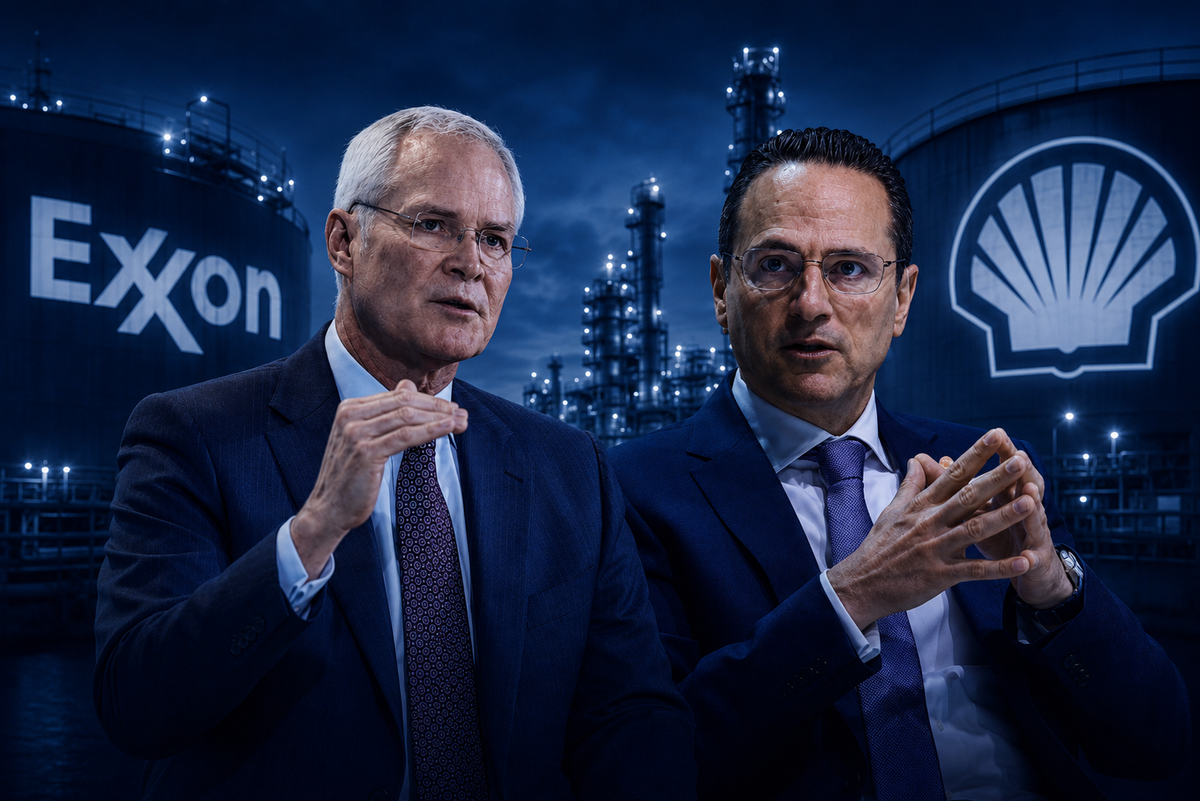
The Financial Times recently published a substantial profile piece of ExxonMobil and its chief executive, Darren Woods, under the title The King of Big Oil. The title suggests a conventional story about operational success, scale and corporate recovery. Those elements are there to begin with, but the article then becomes about power: who sets the strategy, how much freedom management should have to pursue it, and how far a company can go to insulate itself from activist shareholders pressing oil companies to pivot faster towards the energy transition.
Exxon’s first major encounter with this kind of activist pressure came five years ago, when a small hedge fund called Engine No. 1, which owned just 0.02 per cent of the company’s shares, managed to force the departure of three Exxon directors in a proxy battle over what it described as weak climate policies and poor financial performance. The timing was significant given its campaign followed the collapse in Exxon’s share price during the pandemic, when lockdowns sent oil demand sharply lower. For a brief period, Chevron, America’s second-largest oil company and Exxon’s long-standing rival, overtook it in market capitalisation.
Exxon has spent much of the period since then pushing back against pressure from climate activists and ESG-focused investors. The company sued two shareholder groups after they submitted a climate proposal, continued the case after the proposal was withdrawn, changed aspects of its shareholder voting arrangements and, most recently, won shareholder approval to move its legal domicile from New Jersey to Texas. Critics argued that some of these moves weakened shareholder rights. Exxon presented them as necessary responses to the misuse of the shareholder proposal process and an increasingly unpredictable governance environment.
The FT article presents this campaign against a background of remarkable corporate recovery. Woods is not fighting from a position of weakness. Remember when Chevron briefly surpassed Exxon by market capitalisation during the pandemic? Exxon is now around 70% larger. It has also reached a 40-year high in annual upstream production, at 4.7 million barrels of oil equivalent a day, and says it has delivered $15.1 billion of structural cost savings since 2019. Guyana has become one of the industry’s most important new oil provinces, while the acquisition of Pioneer Natural Resources has transformed Exxon’s position in the Permian.
Exxon’s argument for management freedom is much easier to sustain because the company has since delivered in spades. Five years ago, shareholders had reason to question performance, spending and returns. Today, Exxon is larger, producing more, spending more selectively and operating from a position of considerably greater market credibility.
The Exxon described by the FT now appears determined to make a repeat of the bruising Engine No. 1 experience much more difficult. There are legitimate governance questions around this. Vanguard, which supported Exxon’s directors in 2024, nevertheless expressed concern about the possible chilling effect of the company’s lawsuit against shareholder proponents. CalPERS opposed Woods and Exxon’s lead independent director over the same issue. The company’s move to Texas was also criticised by shareholder-rights groups and proxy advisers.
Exxon is not the only oil major to have faced sustained pressure from climate-focused shareholders. Shell has had its own repeated tussles. In 2024, a Follow This resolution demanding tougher emissions targets was backed by 27 institutional investors managing around $4 trillion and ultimately received 18.6% of the vote. The pressure has continued as Shell has shifted its strategy back towards LNG growth, stronger shareholder returns and tighter spending discipline. In 2025, another shareholder group challenged the assumptions behind Shell’s LNG strategy, while a further Follow This resolution went to the vote in 2026. Shell’s shareholders have consistently backed management, but the company continues to operate within an active, and often distracting, debate over how quickly it should move away from hydrocarbons.
The contrast, therefore, is not between a company exposed to activist pressure and one that is not. It is between two companies that have faced similar pressures, but operate in different jurisdictional landscapes and have responded in different ways. Exxon has become increasingly confrontational and has taken steps to give management greater protection from future challenges. Shell has changed strategic direction under Wael Sawan, but continues to navigate climate resolutions, institutional engagement and the expectations of a more ESG-sensitive European investor base.
That difference in how the two companies have responded to pressure is only one part of a much broader contrast between them. The market is assigning very different values to their expected earnings. Exxon is not merely valued more highly than Shell, the difference is substantial. Using recent share prices and 2026 consensus earnings estimates, Exxon is valued at roughly 12.5 times expected earnings, compared with around 7.8 times for Shell.
The two companies are financially strong, globally integrated oil and gas majors. Yet the market is prepared to pay much more for each dollar of expected Exxon earnings than for each dollar of Shell earnings.
Shell offers the higher dividend yield, at around 4%, compared with approximately 3.3% for Exxon. That is partly a function of Shell’s lower valuation, but it also sharpens the question of what investors believe Exxon offers that Shell does not.
The FT article offers one possible explanation. Investors may be paying Exxon not simply for the assets it owns, but for confidence that management will be allowed to develop those assets and retain a consistent strategy without repeated attempts to change the company’s direction. That cannot explain the whole valuation gap, because the physical portfolios also differ materially.
Exxon can point to two clear upstream growth engines. Guyana is a basin-scale conventional development story built around successive projects and rising production. The enlarged Permian business gives Exxon a second, very different source of growth: a vast short-cycle position with scale, inventory and room for technology and operating improvements.
The combination makes Exxon relatively easy to model. Investors can see new Guyana projects moving towards production and follow progress in the Permian. Shell does not have obvious assets with the same visibility or scale. It owns many high-quality upstream assets and one of the strongest LNG businesses in the industry, but it lacks a recent organic growth engine on the scale of Guyana and an unconventional position comparable with Exxon’s enlarged Permian business.
This difference becomes more important when Shell’s reserve base is examined. Shell ended 2025 with 8.123 billion barrels of oil equivalent of proved reserves and produced 1.022 billion barrels of oil equivalent during the year. On a simple reserves-to-production basis, that is a reserve life of around eight years, a shockingly low number for a company that intends to remain one of the world’s largest oil and gas producers.
The direction of travel is alarming, given Shell’s proved reserves fell from 9.620 billion boe at the end of 2024 to 8.123 billion boe a year later. Divestments explain a significant part of the decline, including changes in Canada and Nigeria, so the headline reduction should not be presented as geological failure. Even so, Shell reported an SEC reserves replacement ratio of negative 40% for 2025 and a three-year average of just 55%.
Those figures do not mean Shell is running out of hydrocarbons in eight years. Future discoveries, projects and acquisitions will add duration. But the contrast with Exxon remains important: Exxon has two visible engines of future production and resource renewal, while Shell’s path to replacing depletion is less obvious.
Shell’s LNG position is the strongest counterweight to a simple upstream comparison, but it also helps explain why the company is harder to value. Guyana and the Permian are comparatively direct: projects are sanctioned, wells are drilled and production follows. Analysts can model volumes, costs, decline rates and timing with reasonable transparency.
Shell’s LNG business is different. Its value sits across equity production, long-term supply contracts, liquefaction access, shipping, destination flexibility, trading and optimisation. Shell can move cargoes between markets, arbitrage regional price differences and capture value from a portfolio that is much more than the sum of its owned upstream reserves.
That is a formidable capability, but it is harder for the market to forecast. Contract structures, shipping positions, regional spreads and trading decisions are not visible like a new FPSO or Permian drilling programme. Shell’s complexity may conceal value, but it can also make the earnings stream harder to place on a high multiple.
The portfolio difference sits alongside a management one. Exxon’s recent record is visible: costs have fallen, Guyana has continued to grow, Pioneer has enlarged the Permian business and production has reached levels not seen for decades. Woods has maintained broadly the same strategic direction through that recovery.
When management repeatedly does what it said it would do, investors are more willing to believe future targets and give spending decisions the benefit of the doubt. The FT article’s focus on management freedom resonates because freedom has value only if shareholders trust the people exercising it.
Shell is building credibility under Wael Sawan from a different starting point. Its strategy is clearer, with greater emphasis on LNG, tighter spending, cost reduction and shareholder returns. Sawan has shown himself to be an effective manager of the existing business: costs are being driven down, spending is being controlled and cash is being returned to shareholders.
The harder question is whether Shell is becoming too good at managing what it already has while doing too little to solve the longer-term problem of resource renewal. Investors are therefore judging not only whether the current strategy will prove durable, but whether operational discipline can be matched by the creation or acquisition of the next generation of large growth assets.
That question leads directly to how the two companies use the cash their existing portfolios generate. Exxon has large, visible opportunities in Guyana, the Permian and elsewhere. Investors who believe those opportunities will earn attractive returns may be willing to accept a lower dividend yield because they expect retained cash to create additional future earnings and growth, whether through organic investment or acquisitions.
Shell has committed to substantial shareholder distributions, offers the higher dividend yield and is carrying out large buybacks. Those returns sit alongside the question raised by the reserve base: is Shell returning surplus cash after funding a sufficiently deep set of future opportunities, or is the market also detecting a shortage of large reinvestment options?
LNG complicates that interpretation because Shell does not need to own every molecule it trades or optimises, and its commercial system can create value without appearing in a simple reserve ratio. Even so, a major integrated company still needs future supply and development opportunities. Trading can optimise a system, but it does not create another Guyana.
Some part of the gap may also come from the markets around the companies. Exxon sits at the centre of the US equity market, embedded in its largest indices and owned by a deep domestic institutional and retail investor base. Shell operates in a European environment more exposed to ESG mandates and climate pressure, while its primary equity market is smaller and less liquid.
Shell is available to US investors through its New York ADS, but that is not necessarily the same thing as being fully embedded in the US equity market. AstraZeneca’s recent decision to replace its US ADRs with directly listed ordinary shares on the NYSE is instructive. The company said the new structure would widen its investor pool, particularly among US domestic institutional and retail investors, and give it greater flexibility to access global capital markets. The implication is that simply making a European company available through a depositary receipt does not necessarily give it the same reach, liquidity or shareholder base as a direct US listing.
That does not mean a New York listing would suddenly close Shell’s valuation gap, but it looks like an easy win that the company should be seriously considering. Resource duration, growth visibility and management credibility would remain unchanged, but market structure may still contribute to the difference. Purchases of Shell’s London-listed shares also generally attract 0.5% Stamp Duty Reserve Tax, while there is no comparable transaction tax on buying Exxon shares in New York. None of these factors explains several turns of P/E multiple on its own, but together they may affect the depth and character of the capital willing to own each company.
So, the valuation gap is not simply a referendum on ESG activism, nor can it be reduced to the idea that American oil companies receive higher multiples because they are American. Exxon has visible resource growth, two large upstream engines, a management team with a strong recent record and a strategy investors can follow through physical assets and production.
Shell has different strengths. Its LNG position is world class, its trading and optimisation capabilities are difficult to replicate and its current management has shifted the company towards tighter spending and stronger shareholder returns. But those strengths sit alongside a short proved reserve life, weak recent reserve replacement and a growth story that is less physically obvious and harder to model.
The gap between Exxon at roughly 12.5 times expected 2026 earnings and Shell at around 7.8 times therefore sits across several overlapping differences: resource duration, growth visibility, portfolio complexity, management record, cash deployment and different political and shareholder environments.
The FT article adds another dimension. Since Engine No. 1, Exxon has not only recovered operationally but spent several years protecting management’s ability to pursue its chosen strategy. Shell has faced some of the same pressures from a different jurisdiction and responded differently. Exxon’s own experience showed how quickly activist pressure can unsettle investors when it arrives at a moment of weak performance and strategic uncertainty. Shell is not in the same position today, but the potential effect of renewed ESG pressure on market confidence should not be dismissed. The valuation gap now sits alongside those differences in assets, resource duration, strategic consistency and the environments in which the two companies operate.