ConocoPhillips got bigger, but did it get better?

Before I began researching this article, I assumed ConocoPhillips was a relatively simple corporate story. It had spun off Phillips 66, disposed of much of its international inheritance and concentrated on unconventional oil and gas in the Lower 48. Successive purchases of Concho Resources, Shell’s Permian assets and Marathon Oil then turned it into a larger version of the post-separation business.
That captures the rough direction of travel, but it is an inadequate description of what ConocoPhillips has become. The company did not simply withdraw into shale. It made shale the engine of the business, but retained or acquired assets whose production profiles, investment cycles and commodity exposures could compensate for some of shale’s weaknesses and reduce the concentration risk inherent in a portfolio heavily weighted towards unconventionals.
The result is unusual. ConocoPhillips is neither an integrated major nor a conventional US independent. It is an audacious and still unproven attempt to construct the scale, diversity and resilience of a major entirely within upstream.
A company still being assembled
Today, ConocoPhillips is one of the world’s largest independent oil and gas producers. Production averaged 2.375 million boepd in 2025, of which 1.484 million came from the Lower 48. Marathon Oil, acquired in November 2024, helped drive a 20% increase in reported group production and deepened the company’s positions in the Permian, Eagle Ford and Bakken.
Marathon has been integrated operationally, but COP is still reshaping the enlarged company. Management is reducing costs, reviewing the portfolio and deciding how quickly to develop a much larger unconventional inventory while financing several substantial long-cycle investments. Willow, its large new oil development on Alaska’s North Slope, was 50% complete by the end of the first quarter of 2026. North Field East remained scheduled to start during the second half of the year, although disruption in Qatar had introduced uncertainty around the timing of the North Field programme. A broader LNG portfolio was also being assembled around Qatar, Australia and Port Arthur on the US Gulf Coast.
Higher commodity prices are welcome, but make COP more difficult to judge. They can accelerate debt reduction and support distributions, but can also conceal operating weakness. Marathon remains too recent for its eventual outcome to be known, while the cost reductions and portfolio changes now under way show that the acquisition phase has not fully settled. After several years of rapid strategic change, COP still has to prove that what it has assembled is worth more than the assets it bought.
A major without integration
Readers of the recent articles on Exxon, Chevron, Shell and BP will already be familiar with the integrated-major model. COP has no large refining network, chemicals division, fuel-retailing system or broad collection of power and renewable businesses. Most of those operations were placed in Phillips 66 when the company was split in 2012.
The business today is overwhelmingly upstream. The Lower 48 accounts for most output, led by the Permian, Eagle Ford and Bakken. Alaska adds a large conventional oil position, while the international portfolio includes established production and LNG interests across Canada, Europe, the Middle East, North Africa and Asia-Pacific.
When commodity prices weaken, COP cannot rely on refining margins, chemicals or retail earnings to offset the upstream decline. Its answer has been to own assets that behave differently from one another: short-cycle wells and long-cycle projects, rapidly declining shale and slower-declining conventional fields, North American gas and internationally priced LNG. Having surrendered the resilience of vertical integration, COP has spent more than a decade trying to recreate some of it within upstream.
From integration to independence
The oil industry was remade by consolidation after the price collapse of the late 1990s. BP combined with Amoco, Exxon with Mobil and Chevron with Texaco. Conoco and Phillips Petroleum followed in 2002, before ConocoPhillips bought Burlington Resources for $35.6 billion in 2006 and greatly enlarged its North American gas position.
The logic was scale and breadth. Refining and chemicals provided some protection when upstream weakened, while large balance sheets financed deepwater fields, LNG plants, oil sands and frontier exploration. US shale introduced a different rhythm: smaller commitments, rapid production and activity that could be adjusted more quickly, but also steep decline rates and a continuing requirement to drill.
When COP separated from Phillips 66 on 30 April 2012, it inherited both traditions. The split, designed under then-chairman and chief executive Jim Mulva, gave existing shareholders two securities whose strategies subsequently diverged: the upstream company and Phillips 66. It exposed COP more directly to commodity prices, but also released Phillips 66 from competition for money within the former group.
The transaction did not create today’s North America-centred producer. Ryan Lance, appointed chairman and chief executive at the separation, initially presented COP as a large, globally diversified independent E&P. Its 2013 strategy combined conventional production, international projects, exploration and growing unconventional positions in the Eagle Ford, Permian and Bakken. The Lower 48 was important, but remained one growth engine within a much broader portfolio.
COP was still trying to grow like the upstream half of a major, drawing on the strategy and institutional habits of the former integrated group, but without the refining, chemicals and marketing businesses that had previously softened the cycle. Its assets were geographically diverse, yet almost all depended on oil and gas prices and required continued investment. The company had separated the downstream cushion while retaining the upstream spending machine.
The 2016 reset
The oil-price collapse that began in 2014 exposed the weakness of that model. The pressure became severe enough for management to cut the dividend in early 2016, striking directly at the proposition offered to shareholders after the separation.
The November 2016 investor meeting marked the decisive break. Production growth moved down the hierarchy. Management instead emphasised a low sustaining price, low cost of supply, balance-sheet strength, spending flexibility and a defined order for cash. Investment needed to sustain production came first, followed by the dividend, debt reduction, share repurchases and only then additional growth.
Assets would be judged through a common cost-of-supply framework rather than protected because they were large, historic or strategically fashionable. Geographic reach ceased to be an objective in its own right, while production growth was acceptable only when it improved cash generation and returns per share.
The new strategy quickly became visible in the portfolio. During 2017, COP announced more than $16 billion of disposals, including its Foster Creek Christina Lake oil-sands interests and western Canadian gas assets. Production, reserves and future options were exchanged for lower debt, reduced sustaining investment and a more competitive remaining resource base.
This was not simply a retreat from the international business. Shale received most of the growth investment because it offered faster payback and flexibility. Established conventional businesses supplied cash and moderated decline, while exploration and long-cycle projects survived in a smaller and more selective form. The international portfolio ceased to be a map of corporate ambition and became a collection of businesses required to justify themselves economically.
By 2019, discipline had become a system. COP presented a ten-year plan built around real WTI of $50 per barrel, annual spending below $7 billion and more than $50 billion of free cash flow. In 2013, management had described projects and production additions. By 2019, it was describing limits: how much the company would spend, how low the cost of supply should be, how the balance sheet would behave and how much cash shareholders should receive. Modern COP was born not in the 2012 separation, but in the 2016 rejection of the strategy that followed it.
From pruning to buying
COP had improved itself by selling assets, lowering debt and concentrating money on its strongest existing opportunities. The agreement to acquire Concho Resources in 2020, completed in January 2021, changed the method. Concho brought one of the largest unconventional positions in the Permian, with contiguous acreage, shared infrastructure and the opportunity to spread costs across a larger production base.
Management argued that a larger portfolio could still be governed by the rules developed while the company was shrinking. That was not necessarily inconsistent. A disciplined company should be capable of buying when acquired assets are worth more inside its portfolio than the price paid to the seller. But deals create a different burden of proof. Management must show not only that the assets are attractive, but that COP is a better owner of them. It must also show that a company celebrated for removing complexity can absorb new businesses without allowing costs and bureaucracy to return.
Same Permian, opposite answers
COP’s purchase of Shell’s Delaware Basin business in 2021 was more than another shale acquisition. It was a moment when two companies facing much the same investor pressure reached opposite conclusions about the same assets.
Shell sold approximately 225,000 net acres, infrastructure and production of around 175,000 boepd for $9.5 billion. Wael Sawan, then Shell’s upstream director, said the transaction reflected Shell’s focus on “value over volumes” and disciplined stewardship of capital. Shell needed to reduce debt, and $7 billion of the proceeds was earmarked for additional shareholder distributions, with the remainder used to strengthen the balance sheet. Asked several years later whether selling had been a mistake, Sawan defended the decision in the circumstances: Shell’s balance sheet needed repairing, while earlier attempts to enlarge its Permian position had failed.
COP saw the assets differently. It already operated in the Delaware Basin and believed Shell’s acreage, pipelines and water infrastructure would be more valuable when combined with its own position. The acquisition offered longer laterals, greater control over development, lower operating costs and a much deeper drilling inventory. Shell was using the Permian to release cash from the portfolio; COP was using the transaction to make the Permian more central to its own.
The contrast became sharper as their strategies developed. Shell moved further towards a company built around gas, LNG, trading and commercial reach. COP doubled down on direct ownership of short-cycle oil and gas resources. Shell concluded that repairing its balance sheet and concentrating on other parts of the business mattered more than retaining a standalone US shale position. COP concluded that the assets could create greater returns inside a larger, operated Delaware Basin business.
Hindsight alone does not settle which company was right. Shell sold shortly before oil prices strengthened, but received $9.5 billion in cash and reduced financial pressure. COP acquired the future production, but also accepted the decline rates, operating costs and continuing investment required to sustain it. The test is whether the combination produced enough operating advantage and additional cash flow per share to justify the purchase price.
The transaction became a clear fork in the road. Shell left the Permian because ownership of the assets was no longer essential to the company it wanted to become. COP bought them because physical resource ownership was becoming the foundation of its strategy.
A company built around shale
Concho and the Shell transaction transformed COP’s Lower 48 position. By the 2023 investor meeting, the company expected annual spending of around $10 billion, production growth of 4–5% and a resource base of approximately 20 billion boe below a $40 cost of supply.
Shale had become the engine because it offered timing control. Wells could be approved individually, production arrived quickly and activity could be adjusted more readily than investment in a conventional megaproject. That flexibility has limits. Shale production declines rapidly, so reducing drilling also means accepting a relatively quick fall in output. A large unconventional business must continually reinvest simply to sustain itself.
I have always regarded heavy reliance on shale as a risky long-term strategy. Its lack of duration is often obscured by technological progress: longer laterals, better completions, improved recovery and lower drilling costs repeatedly extend the apparent life and economics of the resource. That creates an implicit assumption that technology will continue to overcome steep decline rates, maturing acreage and the gradual exhaustion of the best inventory. Conventional fields deplete too, but shale places a particularly heavy burden on continuous technical and operating improvement merely to keep the production machine moving.
COP’s response was to surround that engine with assets operating on different timetables. Alaska added long-lived conventional oil. Norway and other established international fields brought lower-decline production. Qatar and Australia provided LNG and exposure to internationally priced gas, while Canada added resources with different reservoir and production characteristics.
These businesses remain exposed to oil and gas markets and cannot reproduce the full counter-cyclicality of refining or chemicals. What they can do is spread the reinvestment burden through time and reduce the extent to which the whole company depends on continually drilling short-lived wells. COP made the Lower 48 its short-cycle engine, but avoided giving every part of the company the same short production life. Exxon, Chevron and Shell balance upstream with refining, chemicals, trading and customers; COP has attempted to create balance among different forms of upstream itself.
Willow, LNG and Marathon
That explains why COP did not remain the leaner company described in 2019. Its 2023 plan included materially higher spending as management financed an enlarged Lower 48 programme alongside Willow, Qatar’s North Field expansion and Port Arthur LNG. This was not a return to the sprawling exploration model of 2013. COP was committing larger amounts to a smaller number of projects intended to complement shale.
Willow should add long-lived oil in a region where COP already has infrastructure and operating experience. Qatar, Australia and Port Arthur give it exposure to international gas markets without attempting to recreate Shell’s vast trading and customer system. The difficulty is timing: while these projects are under construction, COP must finance both the continuing reinvestment needs of shale and the fixed spending of long-cycle development.
Marathon arrived in the middle of that period. COP agreed to acquire Marathon Oil in May 2024 for an enterprise value of $22.5 billion, including $5.4 billion of net debt. The transaction deepened its positions in the Eagle Ford, Bakken and Permian and added another large body of established unconventional inventory.
Operationally, Marathon fits the strategy developed since Concho. Its assets sit in basins COP understands and can be ranked alongside the existing drilling programme. Duplicated costs can be removed, and management has already increased the expected savings beyond the original target.
Marathon also magnifies the risk. More inventory is useful only if it can eventually be developed without forcing the company to maintain excessive spending. Greater scale may create efficiencies, but also brings more assets competing for money, more management layers and a larger organisation to control.
COP’s subsequent restructuring exposed that tension. In 2025, it announced plans to reduce its workforce by 20–25%. In an employee town hall reported by Reuters, Ryan Lance acknowledged that controllable costs had risen from around $11 per barrel in 2021 to $13 per barrel in 2024 and that management had paid insufficient attention to costs while concentrating on acquisitions. The deals may have added attractive assets, but the organisation around them had become less competitive. A company that spent years removing complexity through disposals had recreated some of it through scale.
Operational integration is therefore only the first stage. The harder task is showing that a much larger organisation can remain as disciplined and efficient as the smaller company it replaced.
One leader, several strategies
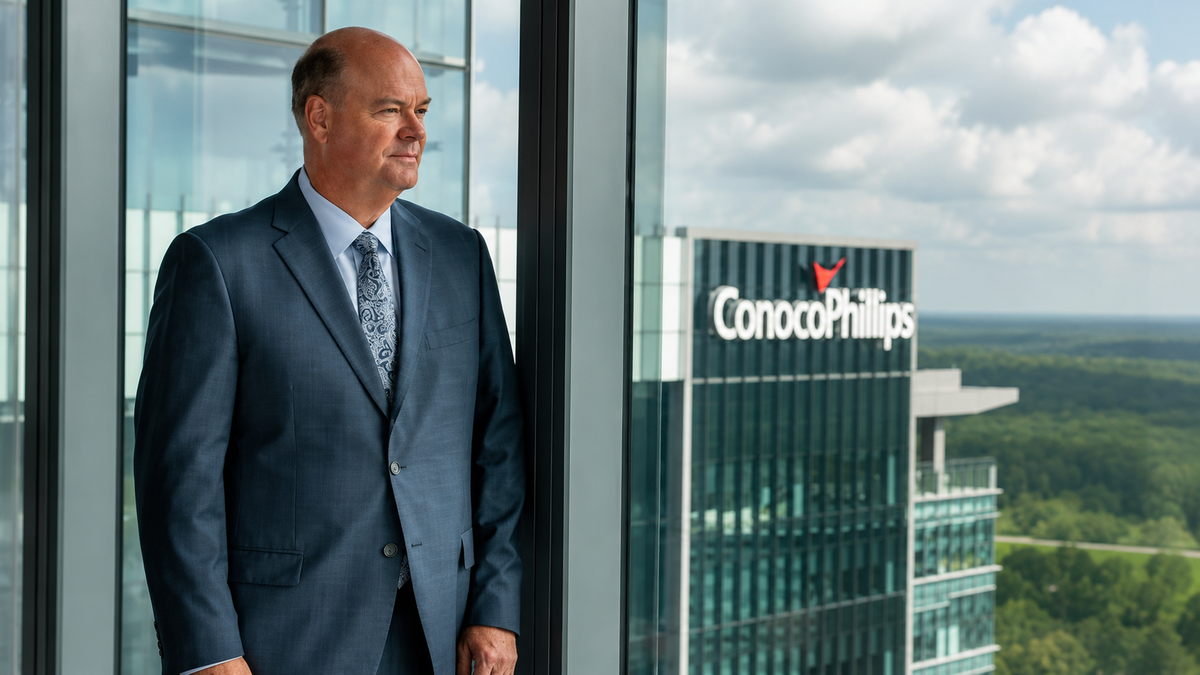
Jim Mulva designed the separation, but Ryan Lance created the company that followed. Lance has served as chairman and chief executive since May 2012, giving COP unusual leadership continuity. He initially promoted a globally diversified E&P, then led the 2016 reset, the large disposals, the 2019 framework, Concho, Shell’s Permian assets, Willow, LNG expansion and Marathon.
The positive interpretation is that Lance recognised the first model was failing and changed it before defending it into irrelevance. COP remained an oil and gas company, but became far more selective about which assets it wanted to own. It established clear financial rules and used its balance sheet to buy large resource positions when other companies were prepared to sell.
The criticism is that the language of discipline has proved capable of supporting every stage of expansion. Concho met the framework. Shell’s Permian assets strengthened the plan. Marathon fitted the portfolio. A system that repeatedly approves large acquisitions must eventually demonstrate that it is capable of concluding the company has enough.
Lance has shaped almost every part of the company COP has become. The question now is whether he regards the portfolio as substantially complete and focuses on converting its scale, inventory and diversity into durable returns per share, or continues using the same framework to justify further expansion.
What shareholders received
COP has produced a good shareholder result, particularly from the 2016 reset through the strong commodity recovery after 2020. Its five-year cumulative total return through the end of 2025 was broadly in line with its weighted US peer group and ahead of the S&P 500 over a period beginning near the pandemic trough.
Longer comparisons are less compelling. COP has broadly matched several large oil peers, but Exxon and some leading US independents have performed better. Its own compensation assessment showed a negative three-year total shareholder return of 3.3% over 2023–25, placing it around the middle of its selected performance group.
The broad conclusion is favourable without being triumphant. COP responded more effectively to investor demands than BP and avoided the strategic reversals that damaged confidence in several European peers. It created a lower-cost company, reduced debt, returned large amounts of cash and built a formidable resource position. But as it moved from disposal-led improvement to acquisition-led growth, the standard of proof rose. Investors no longer need to be convinced that the assets are good. They need to see whether the enlarged company itself is better.
What comes next
COP must now complete its disposal programme, deliver the remaining cost reductions, rebuild financial flexibility and bring Willow and its LNG investments into production. If Marathon performs and the long-cycle projects begin adding cash, the company could emerge with an unusually strong combination of scale, inventory and financial capacity.
There is a strong case for stopping. COP already has a vast Lower 48 position, long-lived Alaska growth, Canadian resources, conventional international production and a substantial LNG portfolio. A period of delivery would allow management to demonstrate what the enlarged company can achieve without immediately changing its shape again.
The case for another Lower 48 acquisition is weak, but not closed. COP has developed an operating system designed to rank assets, vary investment and remove duplicated costs. A further transaction could add contiguous acreage, infrastructure and inventory, although the threshold should now be much higher than before Concho. The company no longer needs more shale simply to establish scale.
A more strategically interesting acquisition would strengthen the long-cycle side of the portfolio. High-quality conventional oil, internationally priced gas or an LNG-linked resource could extend production duration and offset some of the decline embedded in the Lower 48. LNG offers another route through additional equity interests, liquefaction access, offtake or upstream gas linked to international markets.
There may also be another round of simplification. As Willow and the LNG projects begin producing, some mature or peripheral positions may become less important. COP could sell them and use the proceeds for distributions, debt reduction or a more strategically important acquisition.
The Shell Permian transaction shows where future opportunities may originate. COP does not need to find poor assets. It needs assets that are worth more within its own portfolio than within the seller’s. Majors simplifying their upstream exposure, independents with constrained balance sheets, private-equity portfolios seeking exits and companies unable to fund both development and distributions could all create opportunities.
A transformational corporate acquisition would be the most exciting possibility, and the most dangerous. COP now has the size and experience to contemplate transactions that would once have looked implausible for an independent producer. Any such deal would reopen the article’s central question at a much larger scale: would management still be applying the discipline established after 2016, or would that discipline have become a language through which almost any expansion could be defended?
A bigger upstream company, but is it better?
COP did not separate Phillips 66 and immediately discover the strategy it follows today. It initially tried to preserve the breadth and growth ambitions of an international major inside a pure upstream structure. The oil-price collapse exposed the weakness of that model.
Management then sold assets, reduced debt, lowered the cost of sustaining production and imposed a common economic test across the portfolio. Lower 48 unconventional production became the engine because it offered speed, flexibility and inventory. Alaska, conventional international production and LNG remained because they brought different production lives, market exposures and spending cycles.
That design is coherent and represents a thoughtful attempt to create resilience inside a pure upstream company after refining, chemicals and much of midstream were removed. The recent acquisition phase, however, has made the company harder to judge. Marathon must show that greater scale has not diluted the discipline established after 2016, while Willow and LNG must convert years of spending into durable cash flow.
COP spent much of the last decade proving that an upstream company could become stronger by becoming more selective. It has now spent several years becoming much larger.
The next few years therefore matter more than the last few. Investors no longer need another presentation explaining the logic of the acquisitions. They need to see what the enlarged company looks like when the buying stops.
If lower costs, stronger cash flow and higher returns per share emerge, management will have earned the right to buy again. If another major acquisition comes first, shareholders should be sceptical of another round of synergy targets and claims that the deal will create value. COP must first prove that the acquisitions it has already made justified the price paid. Permission for the next deal can only be earned by delivering on promises already made.