Chevron’s Different Bet

🎧 Prefer to listen?
We previously examined how Shell changed after acquiring BG Group in 2016. The deal deepened Shell’s exposure to natural gas, LNG and the increasingly complex markets through which gas molecules are produced, traded, transported and sold. Over the following decade, Shell’s commercial reach expanded while its production, proved reserves and reserve life declined. The question was not whether Shell had generated shareholder returns, because it had, but whether those returns were increasingly being produced while the physical upstream business was being run down.
Chevron faced much the same external environment. It entered 2015 after the collapse in oil prices, then experienced the energy-transition investment boom, the pandemic, the European energy crisis and the market’s subsequent return to energy security and reliable supply. Yet Chevron followed a markedly different path. It did not attempt to reinvent itself as a broader energy company, nor did it build its strategy principally around LNG trading and optimisation. It remained centred on owning and operating physical oil and gas assets, although the way it pursued that objective changed considerably over the decade.
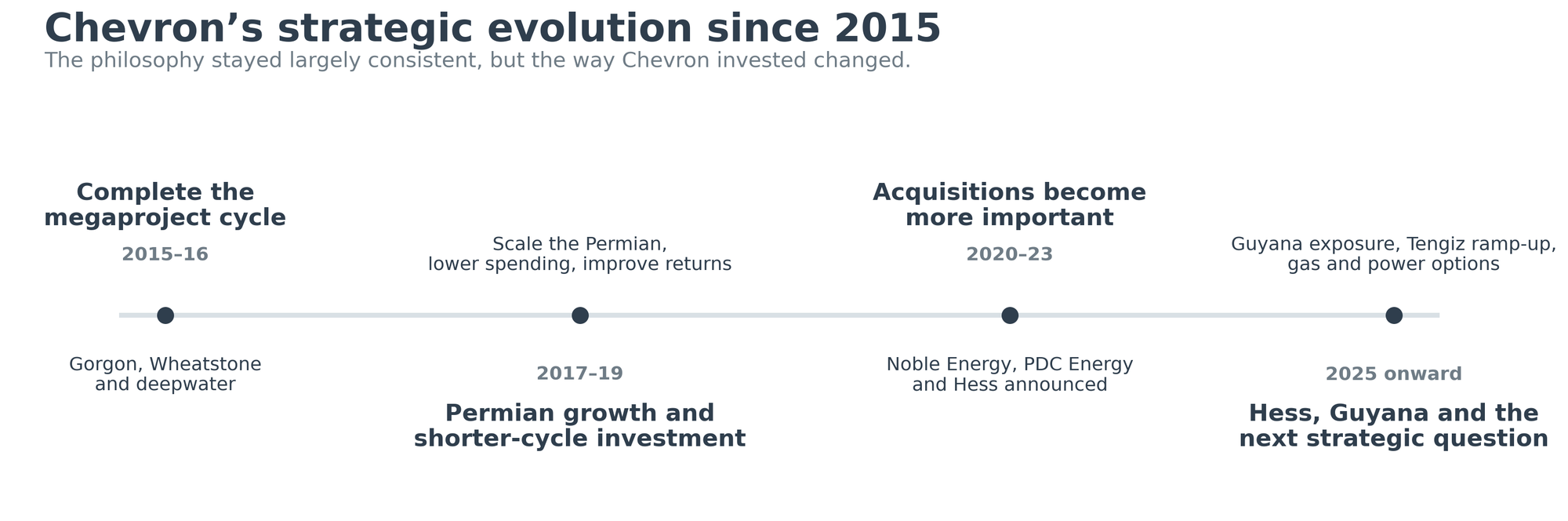
A company caught at the end of the megaproject era
Chevron entered 2015 carrying one of the largest investment programmes in the industry. Gorgon and Wheatstone in Australia, together with a series of deepwater developments, had been conceived and sanctioned in a different period, when investors were more willing to reward oil companies for replacing reserves, building project pipelines and delivering future production growth. By the time those projects were nearing completion, the market’s view had changed. Shareholders increasingly wanted lower and more predictable spending, stronger free cash flow and a clearer claim on the cash generated by the business.
Chevron had already committed billions of dollars to projects that would take years to complete, and those projects had first claim on much of its available cash. The company continued to protect its dividend, but buybacks, balance-sheet repair and other discretionary shareholder returns became residual after the investment programme had been funded. Chevron therefore entered the decade with a portfolio built for the priorities of the previous investment cycle just as investors began demanding something very different.
Gorgon and Wheatstone eventually became large, long-life producing assets, but their construction histories reinforced the market’s growing hostility towards oil-company megaprojects. Gorgon was delayed and substantially over budget, while Wheatstone also suffered cost escalation and schedule slippage. The Tengiz expansion later repeated part of the pattern: the underlying resource was excellent, but the development took longer and cost more than originally expected.
It is tempting to describe these outcomes as sound strategy undermined by poor execution, but that distinction can be too generous. The decision to pursue unusually large, bespoke and technically difficult developments was itself strategic, and suggested how powerful the projects organisation had become within Chevron. If a company repeatedly selects projects whose complexity exposes shareholders to cost overruns and long periods of negative cash flow, execution risk cannot be treated as an unrelated accident. Chevron generally chose resources that ultimately became material producing businesses, but repeatedly underestimated the time, capital and organisational complexity required to convert them into shareholder returns.
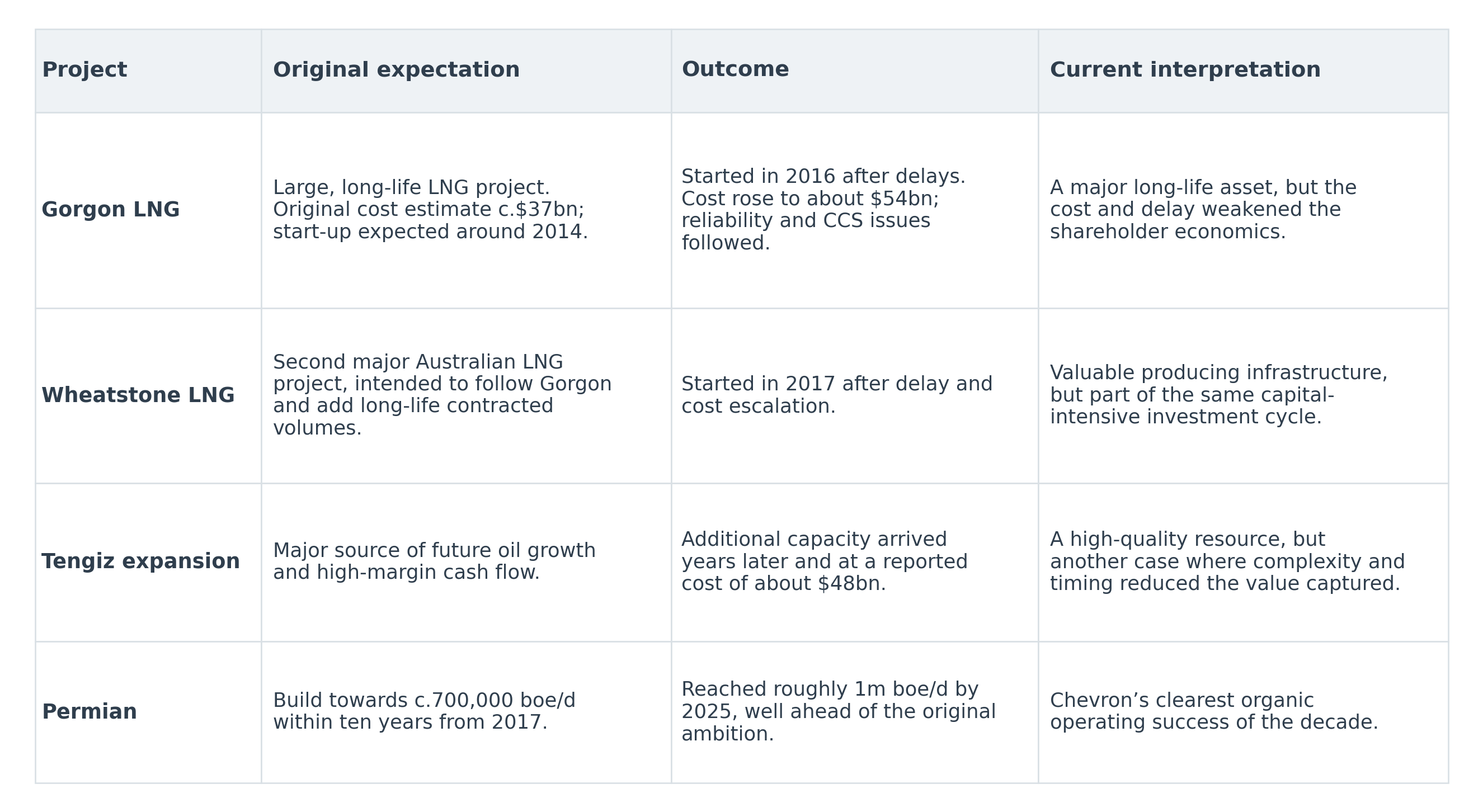
Major Chevron projects — original expectations, outcome and current interpretation
Chevron’s answer was not to retreat from oil and gas. Instead, it changed the mechanism through which it invested. The first phase of the last decade was largely about completing Gorgon, Wheatstone and the existing deepwater programme with as little further pain as possible. The second increasingly centred on the Permian, where spending could be accelerated or reduced more quickly and where Chevron held an unusually large, low-royalty acreage position. The third relied more heavily on corporate acquisitions, beginning with Noble Energy and followed by PDC Energy and Hess.
This progression is interesting because Chevron’s underlying philosophy remained relatively consistent even as its investment model changed. Management continued to argue that long-term value would be created by owning high-quality oil and gas resources, operating them more efficiently and returning surplus cash to shareholders. It did not follow BP into a rapid transition-led reinvention, nor did it move as decisively as Shell towards a model in which gas marketing, LNG optimisation and third-party molecule flows became increasingly important to the corporate proposition.
Production grew, but the reserve base did not keep pace
The operating evidence initially appears to support Chevron’s approach. Production rose from approximately 2.62 million boe/d in 2015 to more than 3.3 million boe/d in 2024, before the Hess acquisition. The addition of Hess, further Permian growth and the start-up of the Tengiz expansion lifted production again in 2025. Unlike Shell, Chevron did not spend the decade running down its production base.
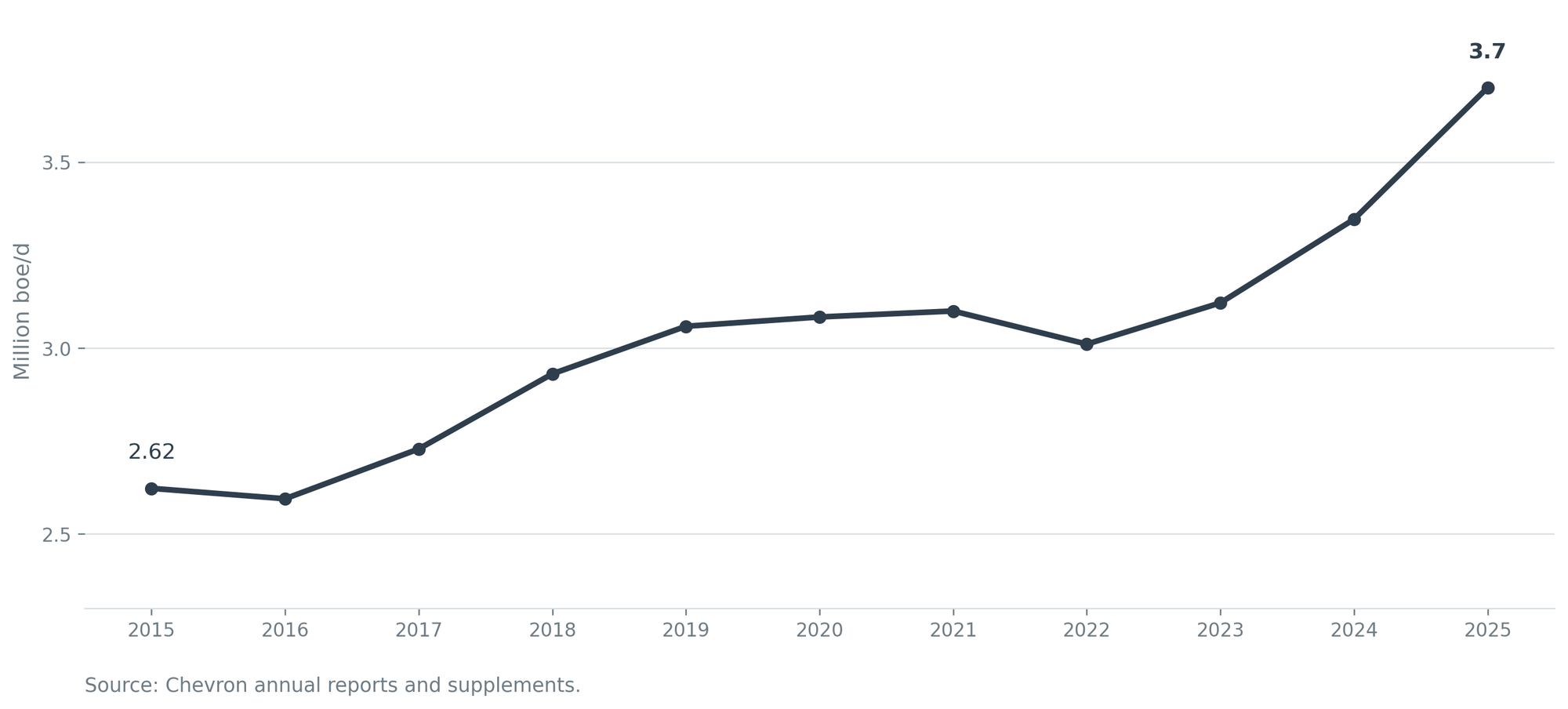
Chevron production has grown since 2015
The reserve position followed a different pattern. Chevron held approximately 11.2 billion boe of proved reserves at the end of 2015, but that figure had fallen to around 9.8 billion boe by the end of 2024 as major projects moved into production and fewer new developments were sanctioned. Hess and other additions lifted reserves to approximately 10.6 billion boe in 2025, yet the enlarged group still had a lower proved reserve base than Chevron possessed a decade earlier.
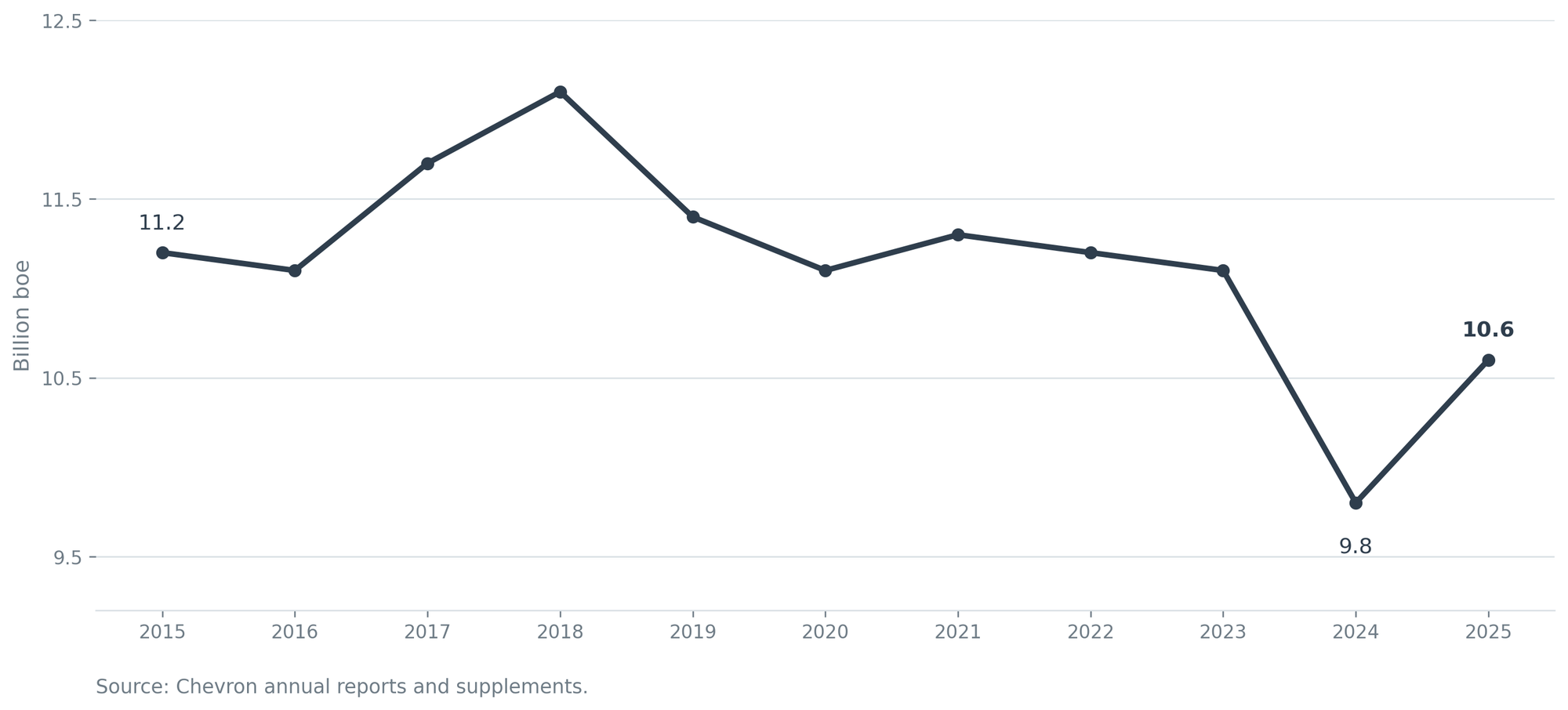
Production growth did not produce sustained reserve growth
The same pattern is visible in reserve life. On a simple calculation of proved reserves divided by annual production, Chevron’s reserve life fell from nearly twelve years in 2015 to roughly eight years before Hess, reflecting both higher production and a slower pace of proved reserve additions. Hess lifted the reserve base, but the ratio remained below its 2015 level.
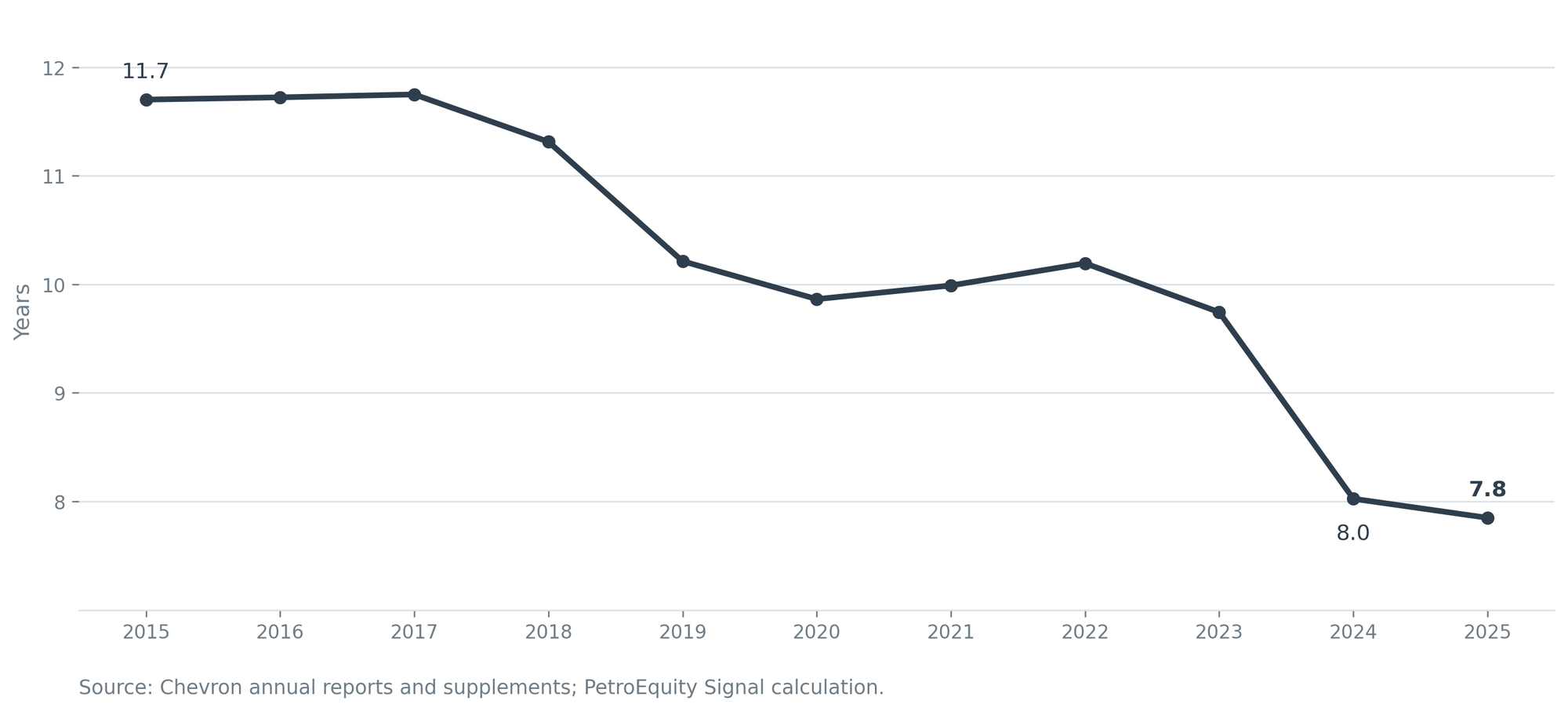
Chevron’s proved reserve life shortened
Proved reserves are not a complete measure of Chevron’s resource depth. The figures are affected by commodity prices, disposals and development plans, while shale reserves can only be booked against a limited forward drilling programme. Even allowing for those qualifications, Chevron’s own replacement measures showed the underlying problem. By 2024, its ten-year reserve replacement ratio was 88%, while its organic replacement ratio for the year was only 45%.
Taken together, the production and reserve trends point to a more nuanced comparison with Shell. Chevron retained a recognisably physical upstream model and produced substantially more oil and gas, but it was not immune from depletion. Organic reserve replacement weakened, production ran ahead of proved additions, and acquisitions became increasingly important to maintaining future growth.
The distinction is not that Shell ran down its physical business while Chevron continually replenished its own. Shell allowed both production and proved reserves to contract while leaning more heavily on the commercial reach of its LNG and gas system. Chevron grew production and retained ownership of large producing assets, but acquisitions became increasingly important in adding the resource duration that its organic portfolio was not delivering fast enough.
The Permian changed the company
The Permian was Chevron’s clearest organic success. In 2017, management spoke of building production towards approximately 700,000 boe/d over ten years. By 2025, Chevron had reached roughly 1 million boe/d, materially exceeding that ambition ahead of schedule. What had once been a relatively small part of the portfolio became a group-scale production and cash-flow engine.
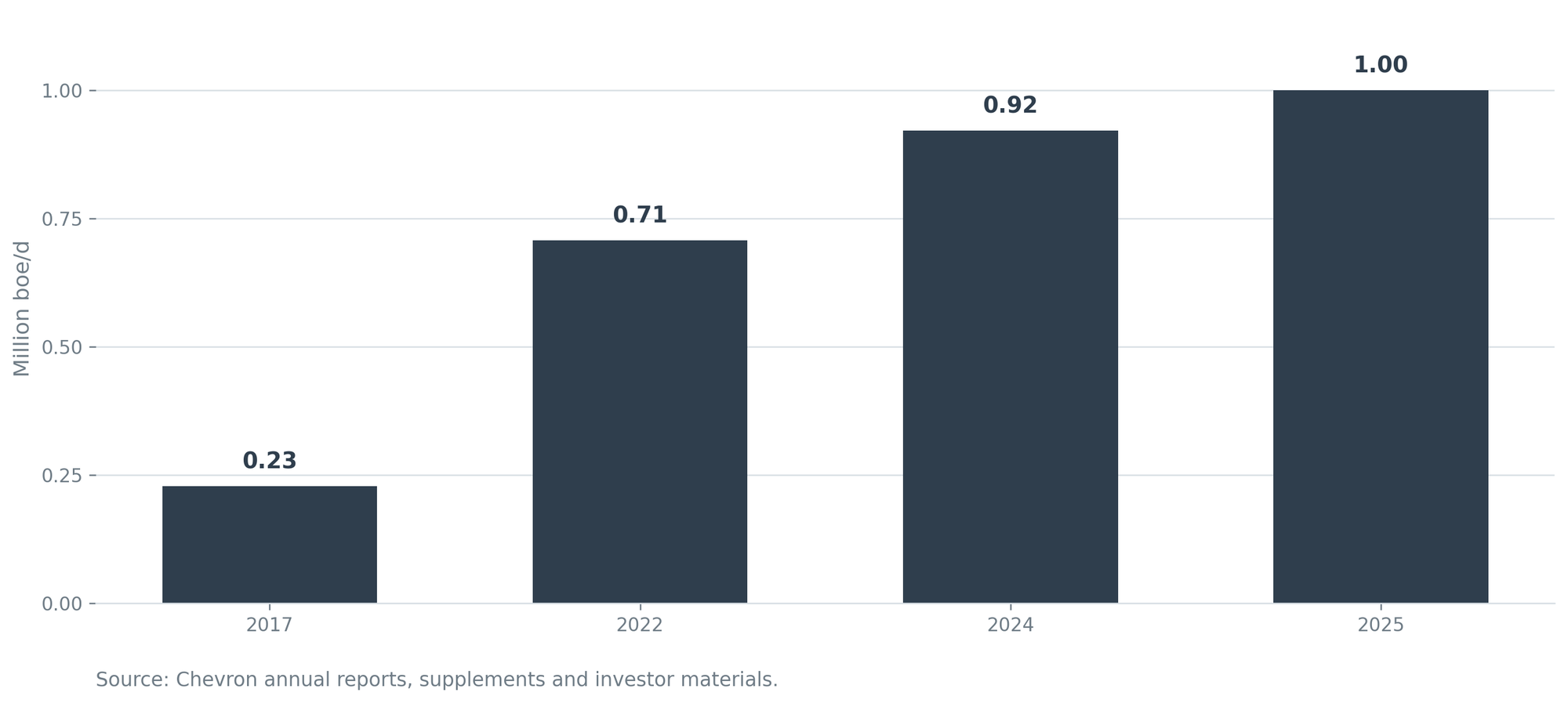
The Permian became a group-scale production engine
The contrast with Shell is particularly useful. Shell sold its Permian business to ConocoPhillips in 2021, using the proceeds partly to strengthen its balance sheet and support distributions. Wael Sawan has subsequently described selling the Permian as a mistake. Chevron stayed, continued drilling and used its acreage position, infrastructure and operating scale to build one of the largest businesses in the basin.
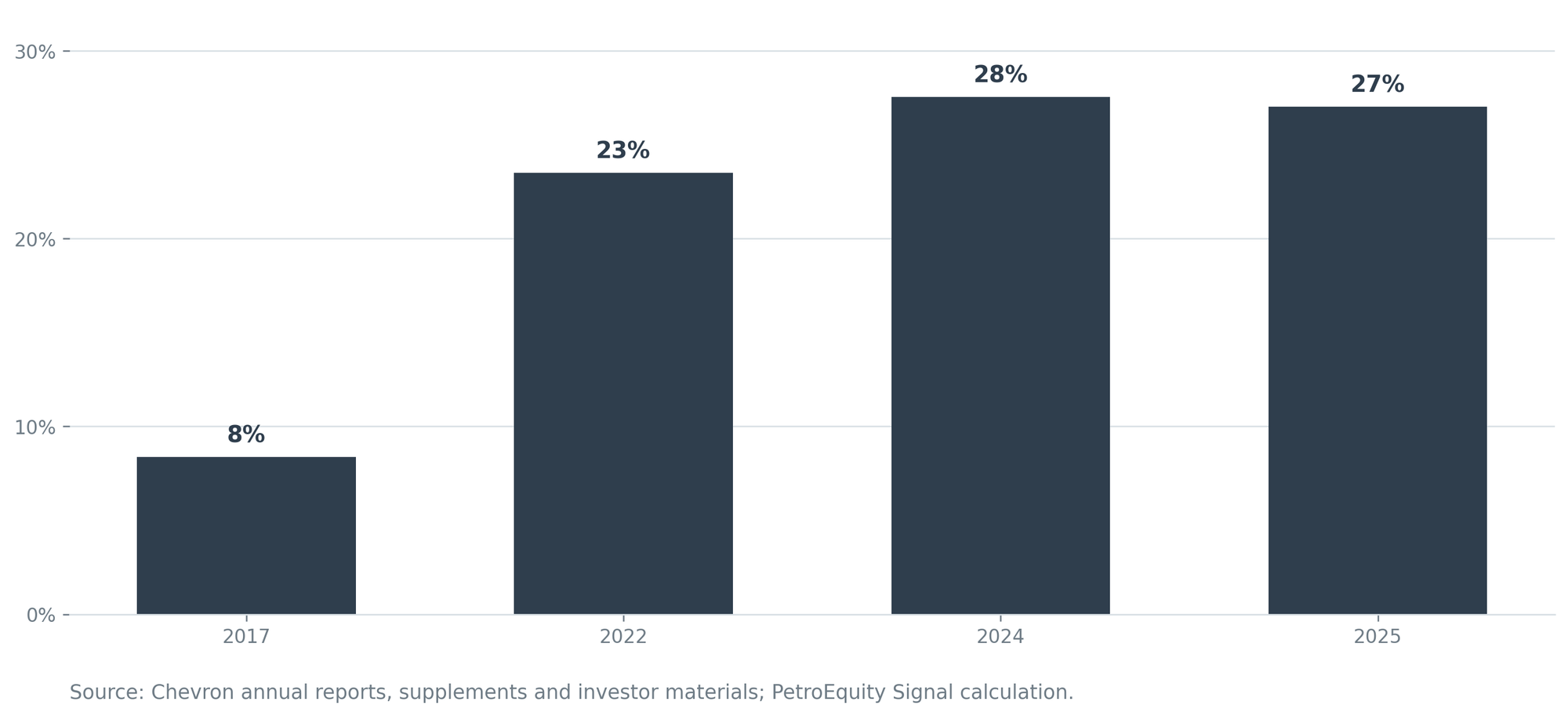
The Permian rose from a minor position to about a quarter of group output
That decision helps explain part of Chevron’s outperformance relative to Shell. The Permian provided visible physical growth, shorter investment cycles and an asset base that could be adjusted more quickly than LNG megaprojects or large conventional developments. It also aligned with what investors increasingly wanted after 2014: spending that could be moderated, projects with faster payback and cash flow that was less dependent on completing another generation of enormous facilities.
The success nevertheless comes with an important qualification. Shale production requires continuing reinvestment, and its decline characteristics differ from those of long-life conventional fields. Chevron argues that the accumulation of thousands of producing wells will create a larger, slower-declining base and allow the Permian eventually to plateau with lower capital requirements. That may prove correct, but the argument depends partly on continued improvements in drilling, completions and recovery factors. Technology can extend the productive life of the resource, but it cannot remove the physical limits of unconventional reservoirs altogether.
What Chevron promised, and what it delivered
Chevron’s investor presentations show how management’s message evolved as this transition took place. In 2015, the priority was to complete the projects already under construction, reduce spending and restore cash-flow coverage. By 2017, the Permian had moved much closer to the centre of the growth story. In 2019, Chevron was promising 3% to 4% annual production growth led by the Permian, Tengiz and a portfolio of smaller, higher-return developments. After the pandemic, the message became more overtly financial, with an emphasis on controlled spending, free-cash-flow growth, cost reductions and shareholder distributions.
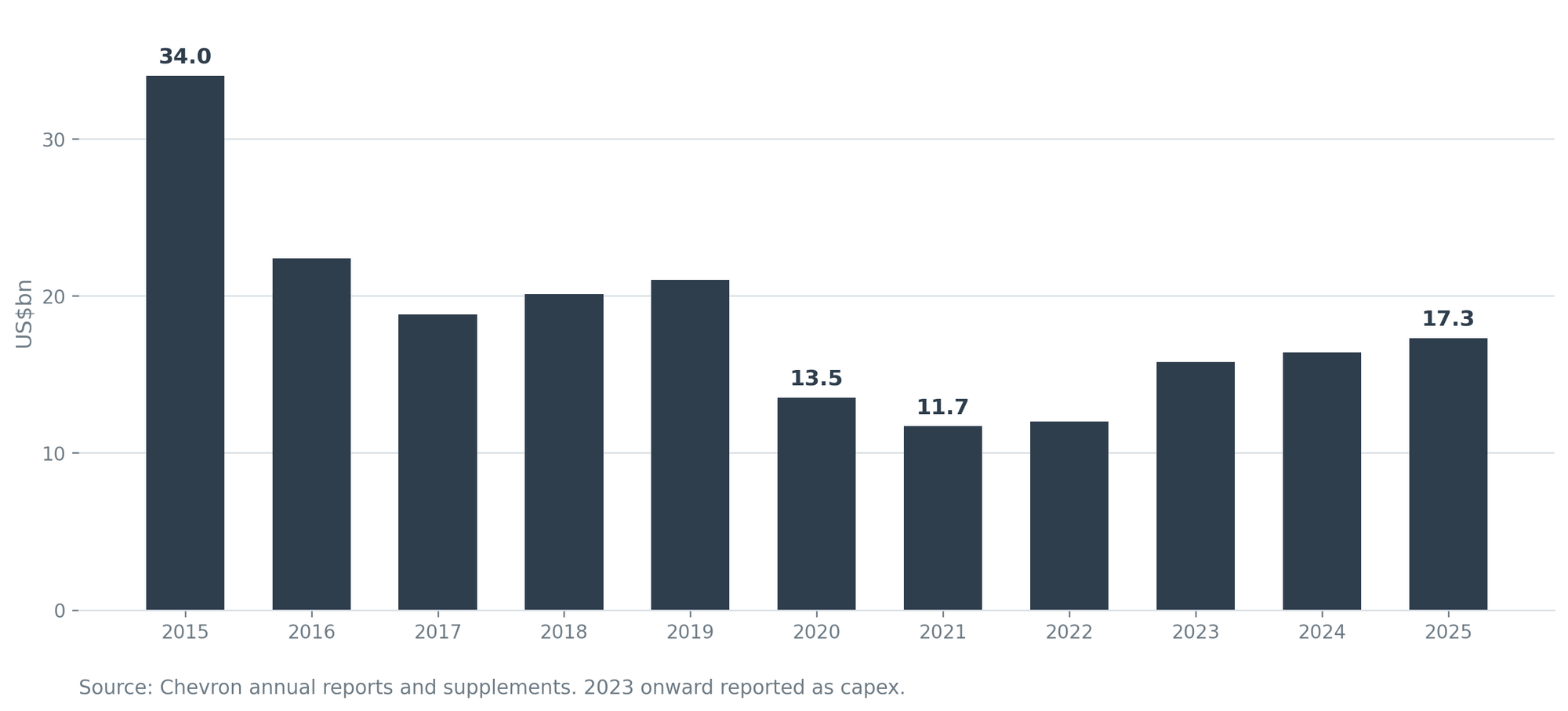
Chevron moved out of the megaproject spending peak
The broad direction of these presentations was usually credible, but the timing was often less reliable. Chevron correctly identified the Permian as a major growth engine and exceeded its early ambitions there. It also anticipated that lower spending and a better project mix would improve cash generation. Yet aggregate production targets were repeatedly affected by delays, asset sales, the pandemic and later changes to the corporate perimeter.
Tengiz is the clearest example. Management repeatedly presented the expansion as a major future source of production and high-margin cash flow. The quality of the resource was never in doubt, but the additional capacity arrived years later and at a substantially higher cost than originally envisaged. Chevron eventually received the barrels, but shareholders waited longer and committed more capital than the original investment case suggested.
The same distinction applies to Chevron’s Australian LNG business. Gorgon and Wheatstone are large, long-life facilities connected to substantial gas resources and important Asian markets. They continue to produce LNG, earnings and cash flow. The question is whether those cash flows adequately compensated shareholders for the cost overruns, construction risks and years during which the projects absorbed capital without providing a corresponding return.
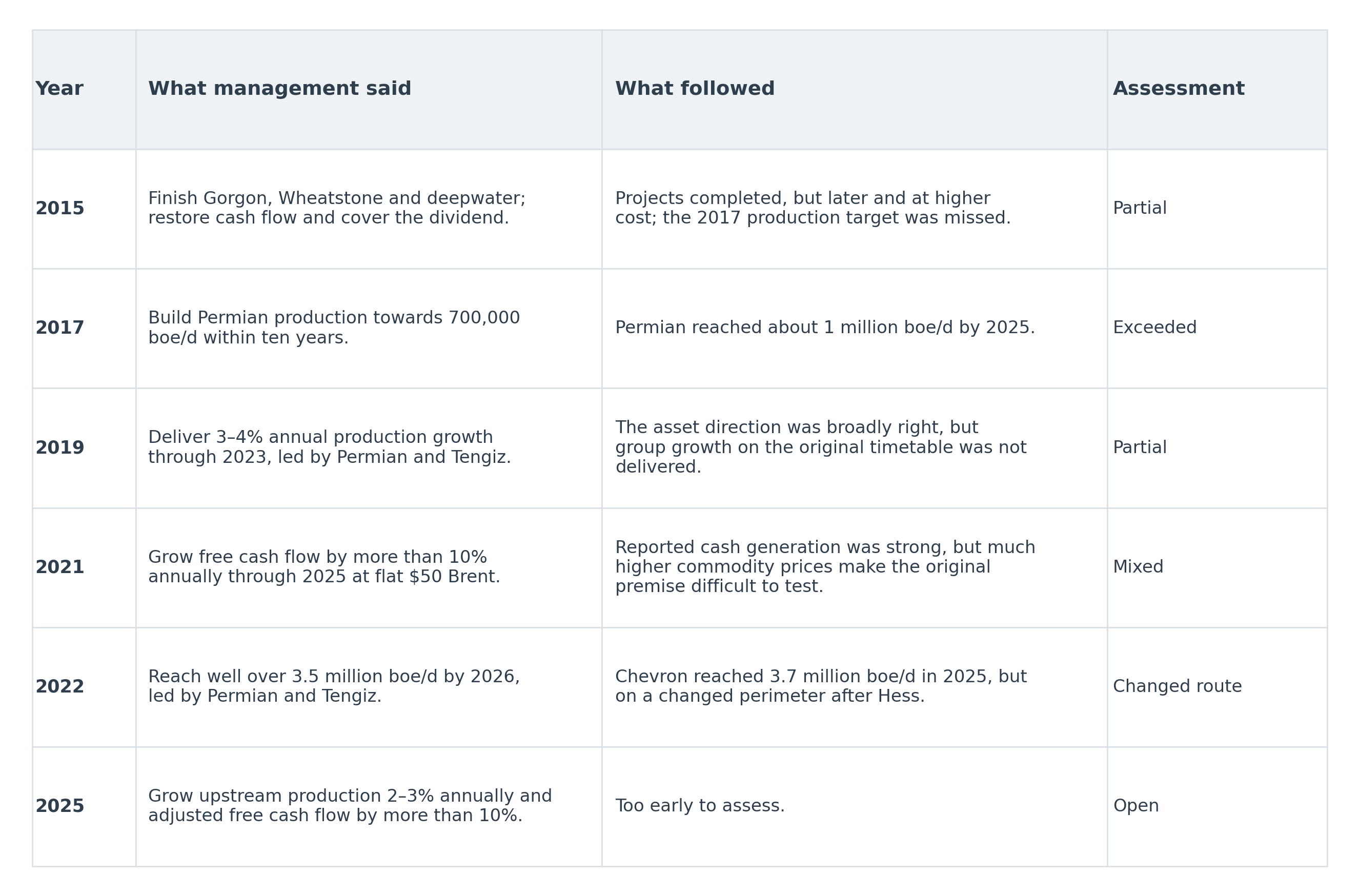
Chevron investor-day (CMD) scorecard
This was the broader market lesson of the post-2014 period. Investors did not conclude that oil and gas projects had no value. They concluded that management teams could not be given an open-ended claim on corporate cash simply because a project would eventually increase production. The return on the capital, the timing of the cash flows and the risk imposed on shareholders became at least as important as the volume being added.
Chevron’s spending pattern shows how the company adapted. Capital expenditure fell sharply as Gorgon and Wheatstone were completed, then remained materially below the pre-2015 peak. Spending later increased as the company expanded the Permian, progressed Tengiz and invested in new projects, but the portfolio became more flexible and incremental. Chevron increasingly preferred repeatable developments around existing infrastructure, shorter-cycle shale spending and acquisitions of already discovered resources to another wave of wholly new LNG megaprojects.
Buying the next phase of growth
The acquisitions reveal both the strength and the weakness of Chevron’s position. Noble Energy, purchased during the pandemic, added Eastern Mediterranean gas, the DJ Basin and other established assets. The transaction was counter-cyclical and broadly consistent with Chevron’s existing strategy. PDC Energy then deepened Chevron’s US shale inventory, particularly in the DJ Basin, and reinforced the short-cycle side of the portfolio.
Hess was different in both scale and strategic significance. The acquisition added a 30% interest in the Stabroek block in Guyana, together with Bakken and Gulf of Mexico assets. Guyana gave Chevron exposure to one of the world’s most important new conventional oil provinces and provided the long-duration, high-margin growth that its existing portfolio increasingly lacked.
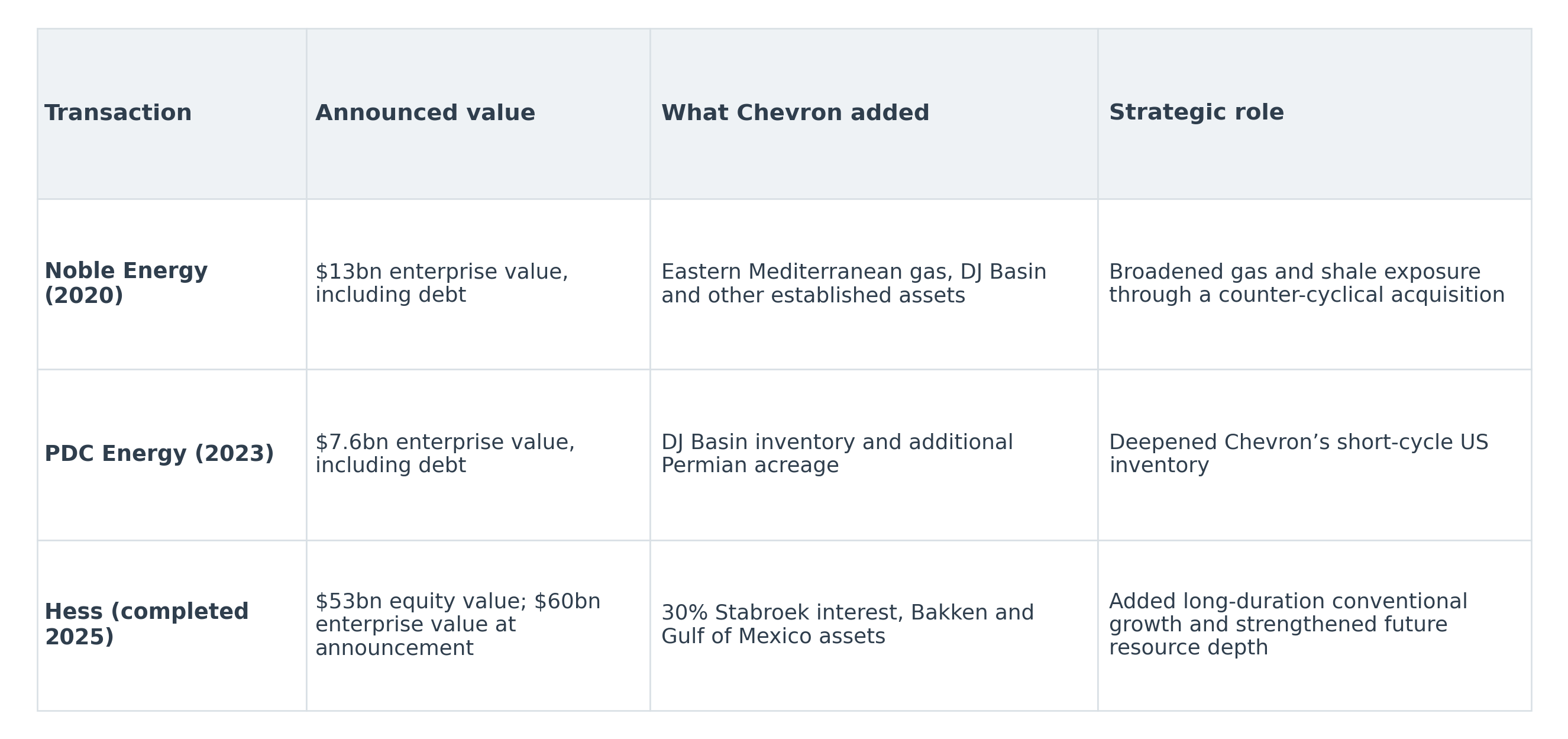
Chevron increasingly bought the inventory it needed
Before Hess, production was strong, but the resource base supporting future output was not being renewed at the same rate. The transaction therefore cannot be understood only as an opportunistic acquisition of an excellent company. It also addressed a weakness in Chevron’s future growth profile.
The acquisition did not, however, give Chevron control of Guyana. ExxonMobil remains the operator and has shaped the development philosophy, project timing and execution standards that made Stabroek the industry’s benchmark. Chevron will benefit from decades of production and cash flow, but it will not enjoy the same strategic influence or operational flexibility as Exxon. Given that Guyana is likely to remain one of the defining assets in the upstream sector for many years, this is relevant.
Exxon provides the closer comparison. It retained and expanded its own Permian position, led the discovery and development of Guyana, and later acquired Pioneer to deepen an already strong physical portfolio. Chevron entered Guyana through a corporate acquisition after the scale and quality of the resource had already become visible. That does not make Hess a poor acquisition, but Chevron had to pay a corporate acquisition price to gain exposure to a resource whose strategic value was already well established.
On Guyana, Shell was Exxon’s early partner in the Stabroek block and withdrew before the major discoveries. It has since acknowledged the missed opportunity. Exxon stayed, Shell left, and Chevron eventually paid to join through its acquisition of Hess.
The same three companies made different choices in the Permian. Shell sold, Chevron expanded and Exxon later reinforced its position through Pioneer. Taken together with Guyana, those decisions raise a difficult question for Shell: did its increasing fixation on integrated gas come at the expense of two of the most important oil growth opportunities of the decade? Companies that appeared broadly comparable in 2015 now offer investors very different physical businesses and routes to future growth.
Shareholder returns tell only part of the story
The share-price record reinforces the point, although it needs to be separated from the common sector cycle. Chevron, Exxon and Shell were all affected by the oil-price collapse, the pandemic and the re-rating that followed Russia’s invasion of Ukraine. Comparing Chevron with both a US peer and a European peer helps remove some of that sector noise.
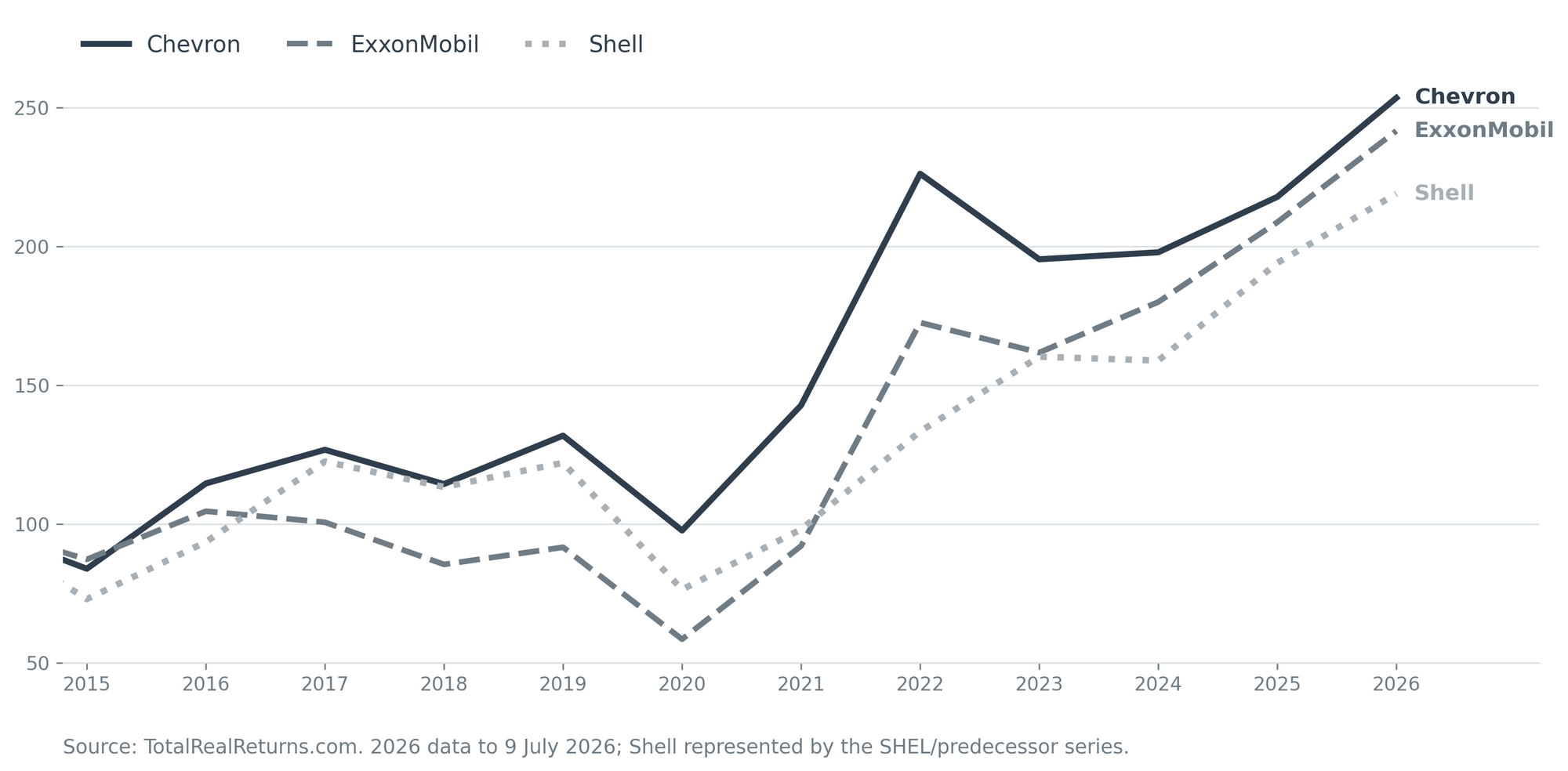
Total shareholder return in US dollars, dividends reinvested. Indexed to 100 at the chart start date. Shell represented by its US ADR and predecessor series.
Over the full period since 2015, Chevron produced a stronger total shareholder return than Shell and broadly comparable or slightly better returns than Exxon, depending on the precise starting and ending dates. Chevron’s relative performance was strongest during the first half of the period, as it exited the peak megaproject spending cycle, preserved its dividend and built the Permian. Exxon’s more recent performance has been stronger, reflecting the market’s greater confidence in Guyana, the enlarged Permian position following Pioneer and the company’s execution record.
Chevron’s outperformance of Shell cannot be explained solely by the common commodity cycle. Chevron maintained its dividend through the pandemic, grew production, retained the Permian and preserved a strategy visibly rooted in owned physical assets. Shell cut its dividend in 2020, sold the Permian and ended the decade with lower production and proved reserves than it had shortly after acquiring BG.
Yet Chevron’s record should not be turned into an uncomplicated story of strategic success. Its strongest production growth came from an asset requiring continual reinvestment. Its largest conventional projects repeatedly exceeded their original cost and schedule expectations, while reserve life shortened and future growth became more dependent on acquisitions. Chevron outperformed Shell, but it did not solve the underlying problem of replacing what it produced without paying heavily for new inventory.
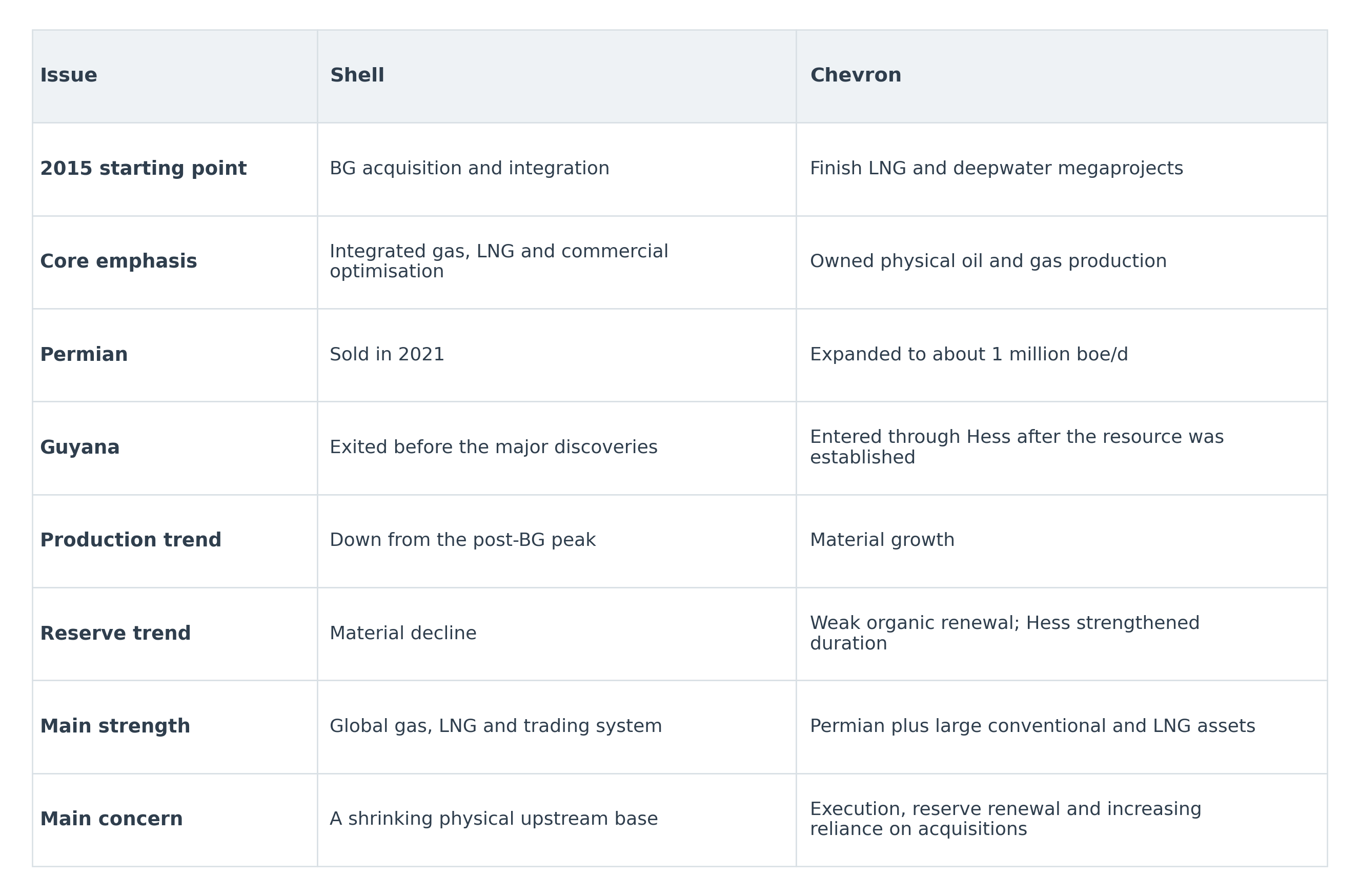
Shell and Chevron — different responses to the same decade
Chevron’s path can be understood as three successive investment waves. The first was the megaproject era, dominated by Gorgon, Wheatstone and large conventional developments. The second was the Permian, with shorter investment cycles, repeatable drilling and greater spending flexibility. The third was corporate acquisition, through which Chevron bought established resources, production and future inventory in Noble, PDC and Hess.
Across all three waves, the corporate philosophy changed less than the method. Chevron continued to believe that an oil major should own and operate high-quality physical assets, invest through the cycle and return surplus cash to shareholders. That consistency helped it avoid the strategic dislocation suffered by BP and the growing questions around Shell’s shrinking physical base. It also produced a company that is larger and more productive than it was in 2015.
What comes next
What comes next is less obvious. Chevron has secured exposure to one of the world’s best new oil provinces, but Exxon operates it. It owns one of the largest Permian businesses, but the long-term value of that position depends partly on continued technical improvement and the ability to manage decline and sustaining investment. It also owns substantial LNG and gas assets in Australia and elsewhere, but has not built the integrated global gas and LNG system that Shell assembled over several decades.
If global gas demand expands through LNG, power generation and data-centre demand, Shell may possess a commercial system whose value becomes increasingly difficult to replicate. Chevron can strengthen its gas position, but doing so without overpaying, rebuilding another capital-intensive megaproject cycle or trying to imitate Shell’s trading model will not be straightforward.
Guyana presents a different constraint. Chevron participates in the economics, but Exxon controls development. The Permian gives Chevron operational control, but it is a shorter-cycle resource whose future production and reserve life remain tied to technology, drilling efficiency and continuing reinvestment.
Chevron therefore enters the next decade from a position of considerable strength without possessing an obvious area of strategic dominance. Exxon operates one of the sector’s most important new conventional oil provinces and has built a broader reputation for execution. Shell has assembled one of the industry’s leading integrated global gas and LNG systems. Chevron owns an impressive balance of long-life conventional assets, shale, LNG and deepwater positions, but its advantage lies in the combination rather than supremacy in one part of the value chain.
For investors, that creates a more difficult choice than a simple comparison of dividend yields or earnings multiples. Exxon currently offers the strongest combination of execution, resource depth and market confidence, but investors already pay a premium for those qualities. Shell trades at a materially lower valuation and offers an attractive shareholder yield, but asks investors to believe that its increasingly gas-centred strategy can offset the decline in its physical upstream base. Chevron sits between them, with stronger production trends than Shell and a lower valuation than Exxon, but with unresolved questions around reserve replacement, operating control in Guyana and the long-term durability of its shale position.
An investor could reasonably prefer Exxon as the highest-quality business, Shell as the cheapest and Chevron as the middle ground between valuation and operational quality. Holding all three would not diversify away the commodity cycle, but it would reduce dependence on a single corporate strategy. It would provide exposure to three different models: Exxon’s leadership in large-scale conventional oil and integrated execution, Shell’s global gas and LNG system, and Chevron’s balanced portfolio of conventional oil, shale and LNG.
The choice is therefore not simply which company has performed best since 2015, but which model is best placed for the next decade. Chevron has assembled a strong portfolio, but it does not yet possess the same obvious strategic franchise as Exxon in Guyana or Shell in integrated gas. Can it build a superior oil and gas business around the Permian, Tengiz, Australian LNG and a non-operated interest in Stabroek, or will it eventually need a more decisive strategic move?
One possibility is that Chevron develops a stronger integrated gas position of its own, using its Australian LNG assets, Eastern Mediterranean gas and growing exposure to power demand to create a more connected business. Another is that it continues to resist that model and relies on a balanced portfolio of oil, shale and LNG rather than specialising. A further pivot cannot be ruled out. Chevron’s strategy has already moved from megaprojects to the Permian and then to large acquisitions. The next phase may again look different from the last.